Unlearning the armour
 Small Experiments for Better Choices Under Pressure Without Losing Us, the Humans

These are 52 powerful, two-minute experiments anyone can try. Together, they form a programme designed to help our community rise above today’s high stress levels and build real resilience—through small, intentional actions that fit into everyday life.
How often have you been told you can’t change the world? Who decided that? What’s really stopping you?
With inner strength, you can become a SUPERHERO.
Every superhero starts with self-belief—then learns how to master their environment. And that’s where we come in. We’re here to help you unlock your power and begin the journey.
Got questions or just want to chat? Book a virtual coffee — a friendly Zoom call about anything from the programme.
List of all the weekly episodes.
A versão em português do cartaz desta semana está disponível aqui.
 Dr Sarah Flindall and Dr Toomas Särev test team culture from a different direction this week: disagreement. Toomas argues that the opposite of collaboration isn’t conflict but suppressed disagreement, and that a quiet room is not necessarily a healthy one. He describes a hospital merger in Stockholm where meetings were full of experienced people nodding along. The real meeting happened afterwards, in the corridor and the lift. Healthy organisations slowly turn those two meetings into one. When leaders ask for views but want endorsement, what looks like alignment is really delayed disagreement. Constructive friction, such as the nurse who says “this works in the policy but will fail at three in the morning”, is not disloyalty but stewardship: crash-testing an idea before reality does.
Toomas’s co-author Claire describes two hospitals moving acute care onto one site. Everyone was on their best behaviour for three months, until what she calls “the explosion of peace”. The peace had been suppression all along, and suppression has a carrying capacity. When the channels finally opened, the colleague who had seemed obstructive turned out to be frightened. Repair has a clock: rush it and you get politeness, leave it too long and you get rot. At home, a family that never argues may simply be one where disagreement has become too costly. Teenagers need proof that they can disagree and the relationship will still hold, even when the boundary stays. With older parents, care can quietly become control, and asking “I know you don’t agree; can we talk about what it is costing you?” protects their dignity.
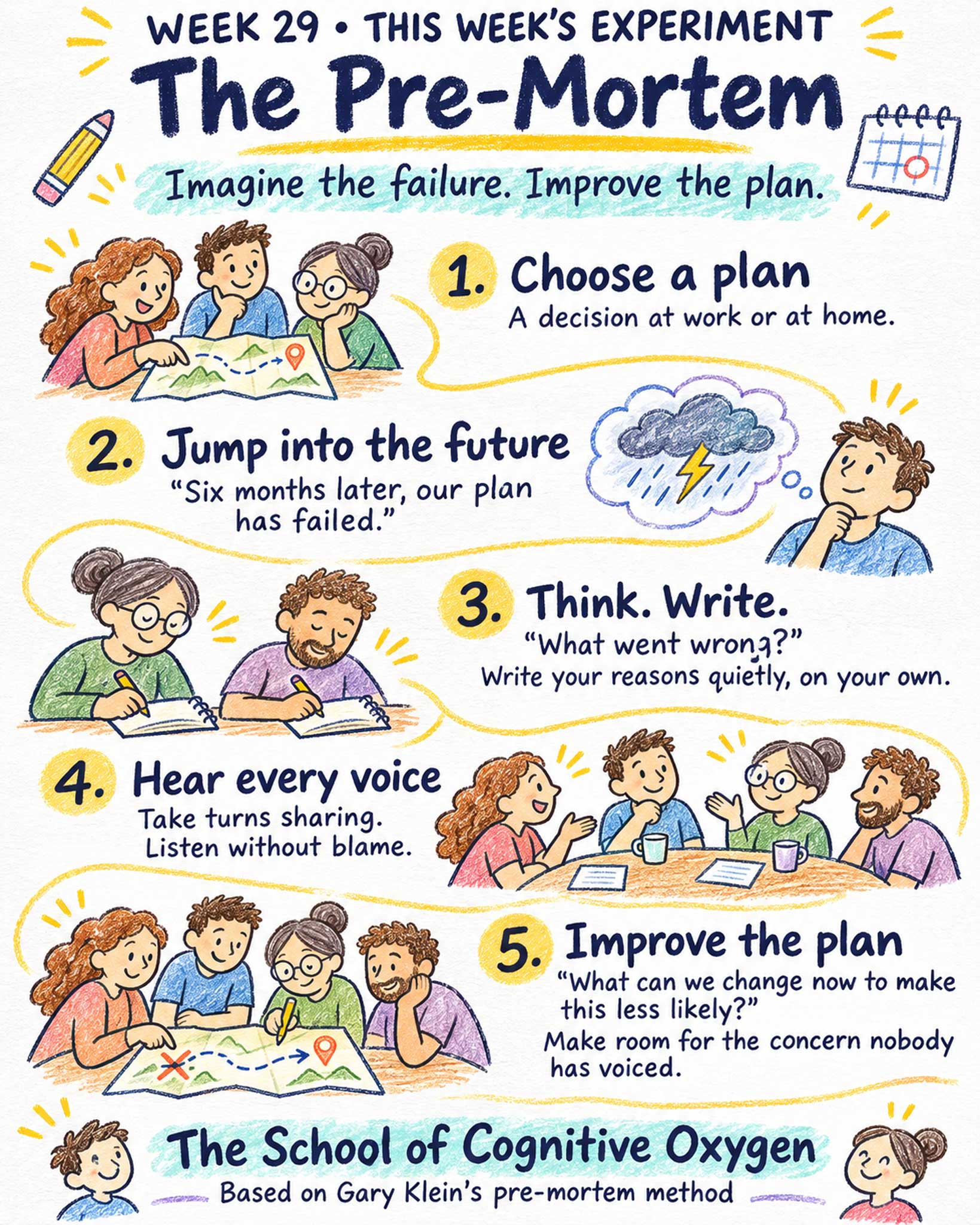
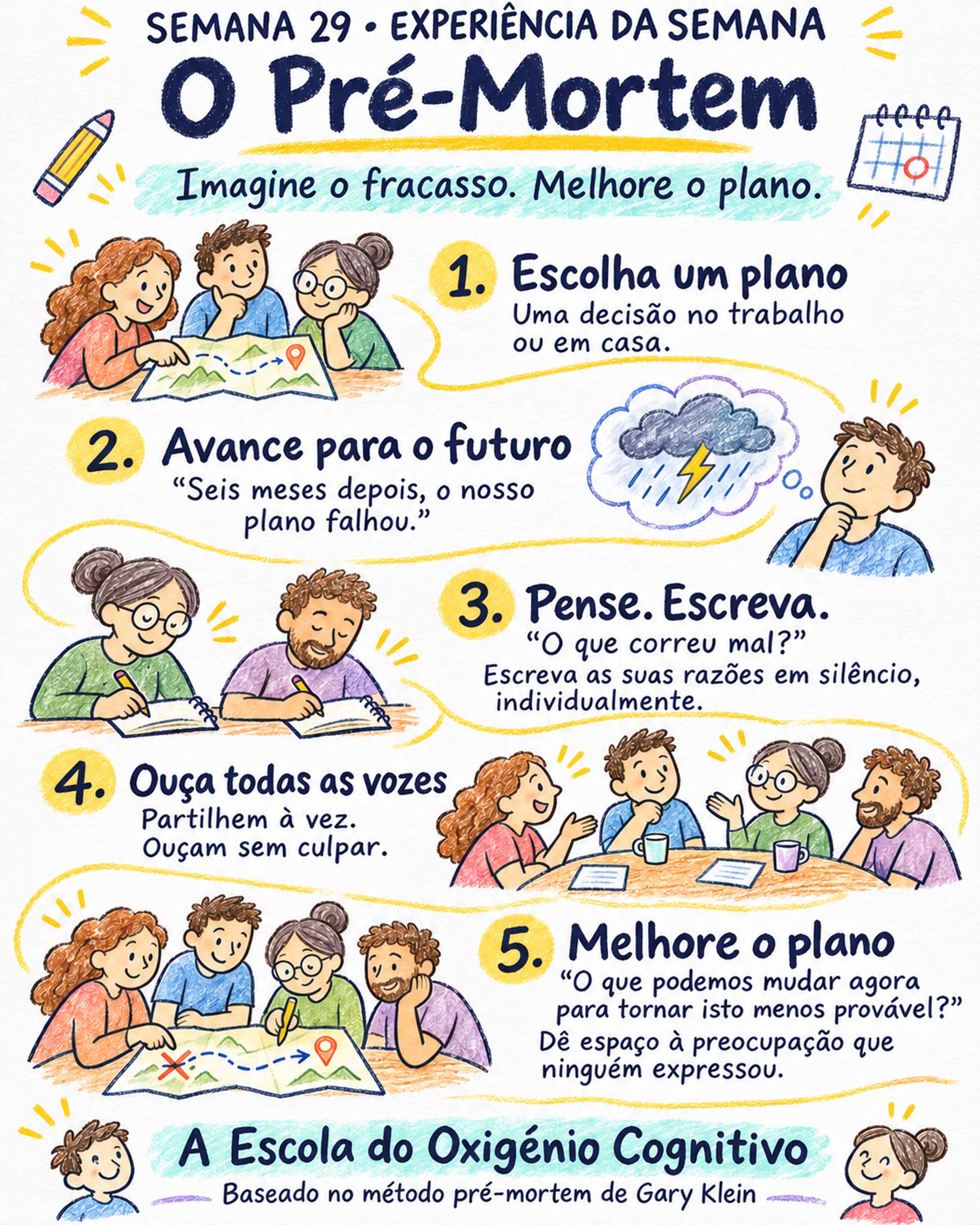
This week’s experiment: “The Pre-Mortem”, from cognitive psychologist Gary Klein. Take one plan or decision at work or at home and imagine it is six months later and the plan has failed. Each person quietly writes down what went wrong, on their own, before anyone shares. Then take turns, listen without blame, and ask: “What can we change now to make this less likely?”
This is not a licence for the loudest voice. The challenge stays aimed at the idea, never at the person’s dignity, and quieter voices come first, which is why the pre-mortem starts in silence. If disagreement always comes from the same three people, that’s just another kind of choreography. Candour without care is brutality, and care without candour is avoidance. Every system pays for disagreement; the only choice is whether it pays during the conversation or after the consequences arrive.
Listen to the full episode below.
- Details
- Written by: Philip Williams
A versão em português do cartaz desta semana está disponível aqui.
 As the series moves into its third quarter, about the systems and conditions people work in, Dr Sarah Flindall and Dr Toomas Särev ask what actually makes a culture supportive. Every organisation claims it on a poster, but Toomas says the gap shows up on a Tuesday afternoon, when the list is overrunning, a colleague has gone quiet and a junior’s smile has gone fixed. Culture is revealed in what becomes possible when things are hard. Can someone ask for help without losing status, or say “I’m not okay today” without being labelled fragile? Values are the claim and culture is the evidence, and when the two diverge, behaviour wins. Toomas treats behaviour as a symptom. Rather than asking who the problem is, ask what conditions make that behaviour rational: workload, safety, incentives, and what leaders quietly tolerate. That doesn’t excuse harm, but it changes the fix. A value only becomes culture when a leader pays a visible price to uphold it. Sarah calls this “the permission in the air”, and Toomas calls it the social soil, grown slowly through small choices nobody sees.
Leaders who perform certainty teach their teams to do the same, and half-formed doubts, which are often where safety begins, go unsaid. A consultant who admits “I found that decision difficult” isn’t weakening the room but calibrating it. Claire, Toomas’s co-author, describes two nurses staying late with a frightened patient with a learning disability, risking the last shuttle bus home, with nobody saying “this isn’t my job”. She calls it the informal infrastructure of a breathable team. The off day matters too: a healthy team can hold one. The same permission applies to the teenager who tests the room before telling the truth, the partner who says “I’m fine”, and the older person whose stoicism may be loneliness in disguise.
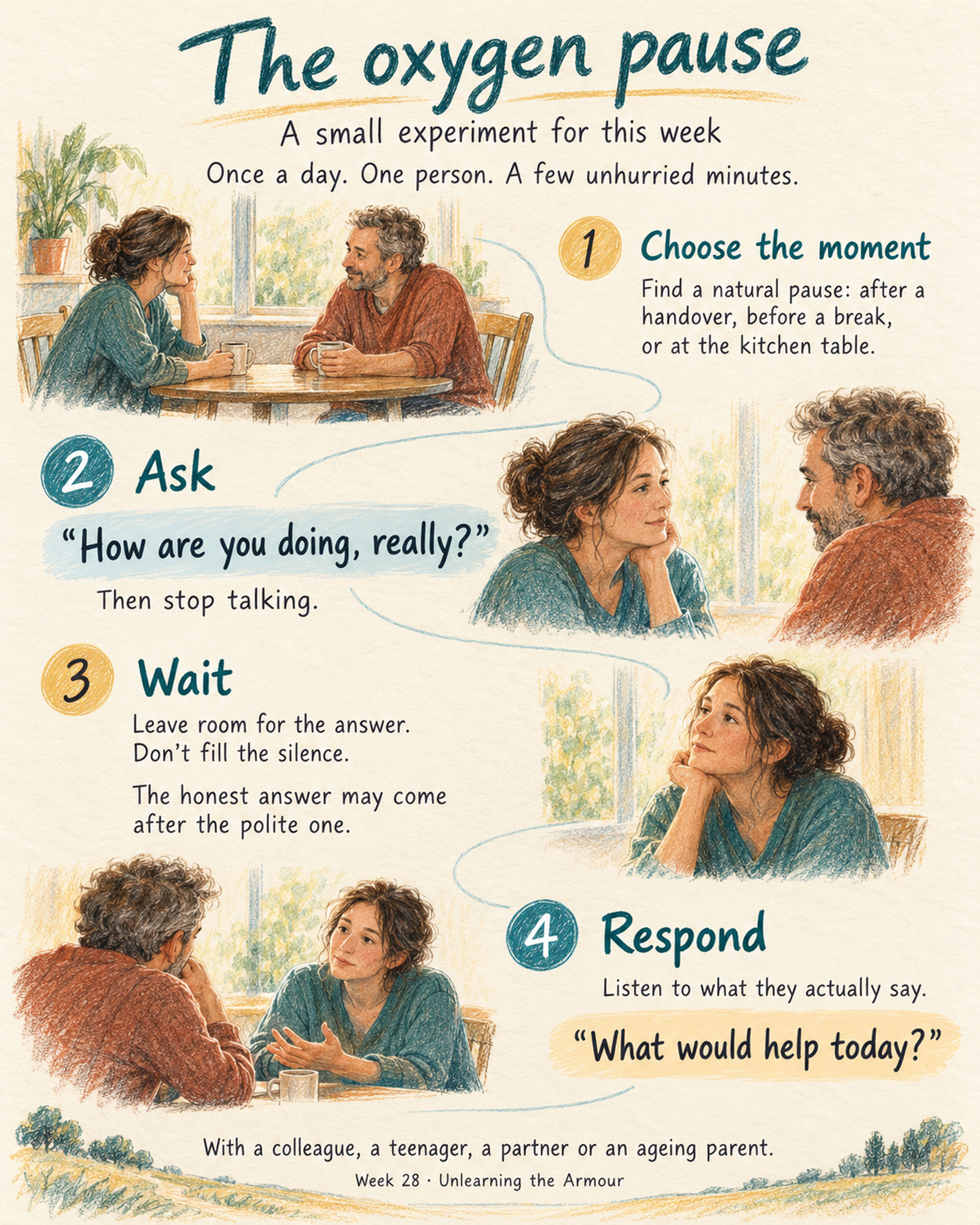
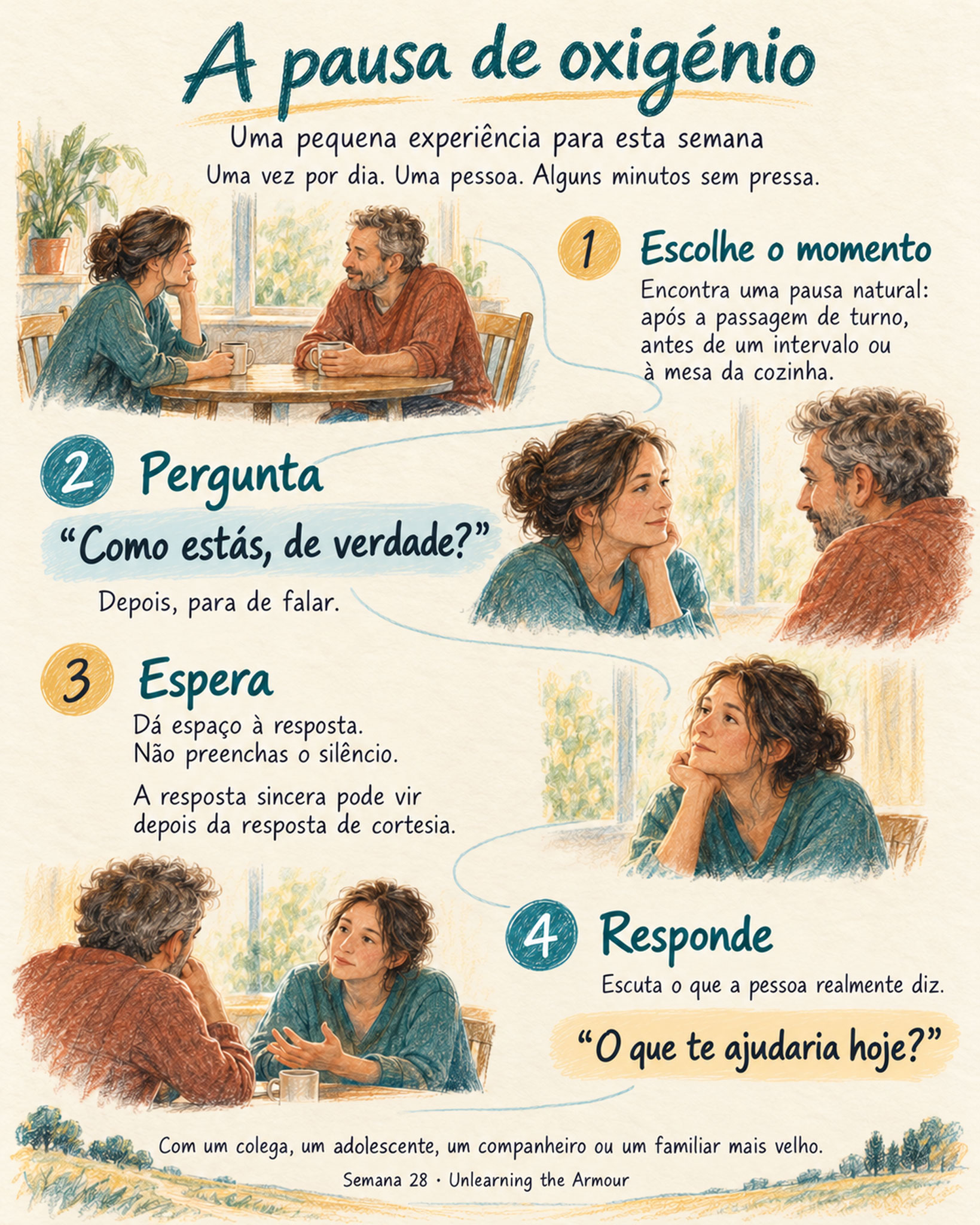
This week’s experiment: “The Oxygen Pause”. Once a day, choose a natural pause, such as after a handover, before a break or at the kitchen table. Ask one person “How are you doing, really?”, then stop talking and wait, because the honest answer often comes after the polite one. Respond to what you actually hear, and if they’re tired, ask “What would help today?”
It’s easy to offer this to people we already trust, but support inside a familiar group may just be loyalty. Culture is tested at the edge of familiarity, with the bank nurse, the locum or the new starter who doesn’t know where anything is kept. The real question is whether trust can begin with a stranger, and someone has to go first.
Listen to the full episode below.
- Details
- Written by: Dr Toomas Särev
A versão em português do cartaz desta semana está disponível aqui.
 Dr Sarah Flindall and Dr Toomas Särev now step back from the space between people to the systems we live and work inside. They start with a word that sounds like a compliment but can hide a wound: resilience. “She’s so resilient” can quietly mean “thank goodness she absorbed it”. People are not bridges that sway and bounce back. Something is carried and something changes, so the word that matters most is recovery. Stress is not the enemy; going without recovery is. Remove the recovery and call people’s survival resilience, and what you have is depletion with better language.
Most teams have one person who always holds it together, and they can become unpaid infrastructure for a system that should have been built properly. As Toomas’s co-author Claire puts it, the ward runs on the goodwill of people too tired to ask for help, and goodwill is not a staffing model. The same goes for the masking teenager, the parent who gets handed more because they’re capable (capability is not capacity), and the older person who won’t complain. Ask them “What has become harder lately that you haven’t told anyone about?”
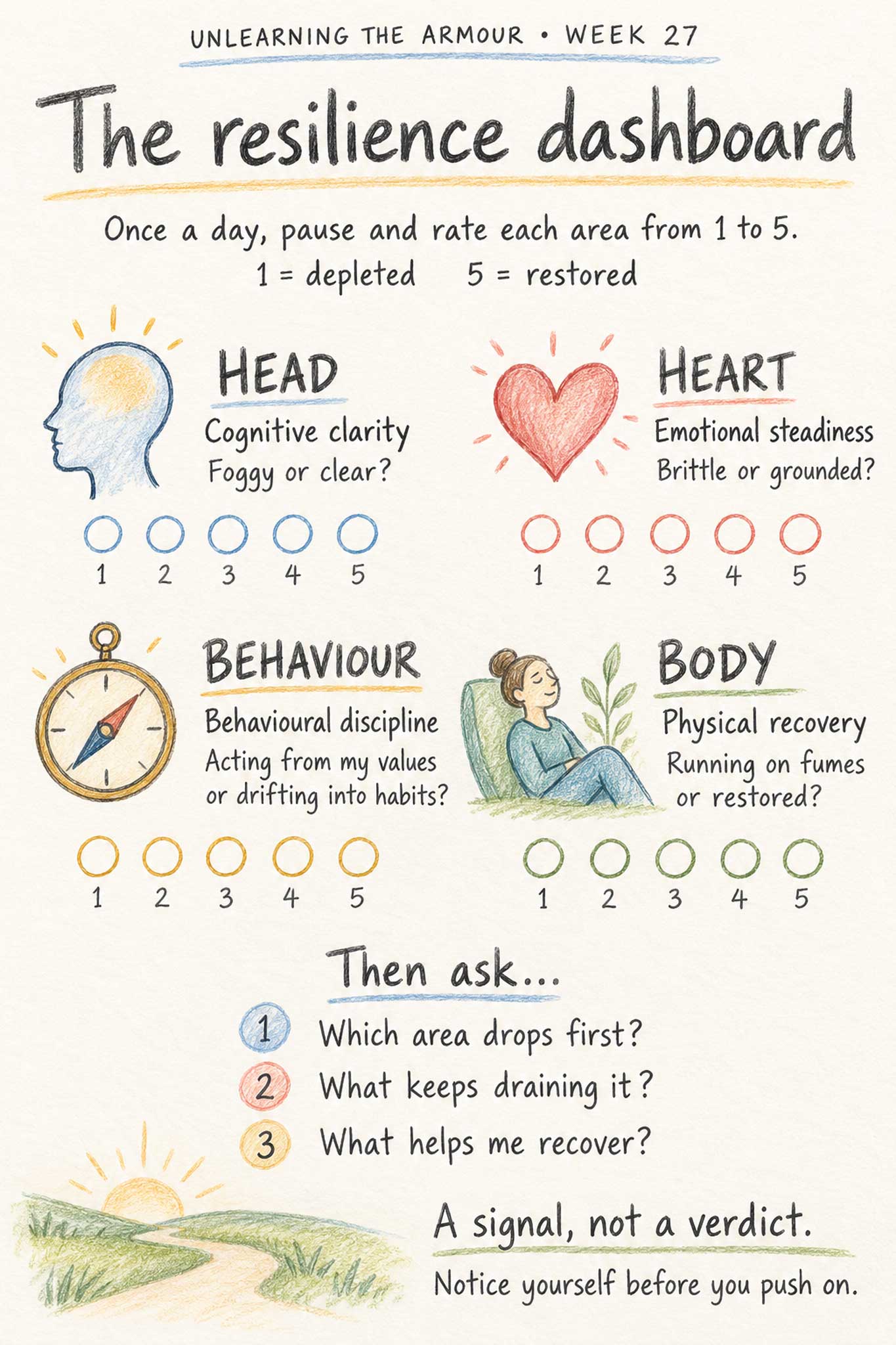
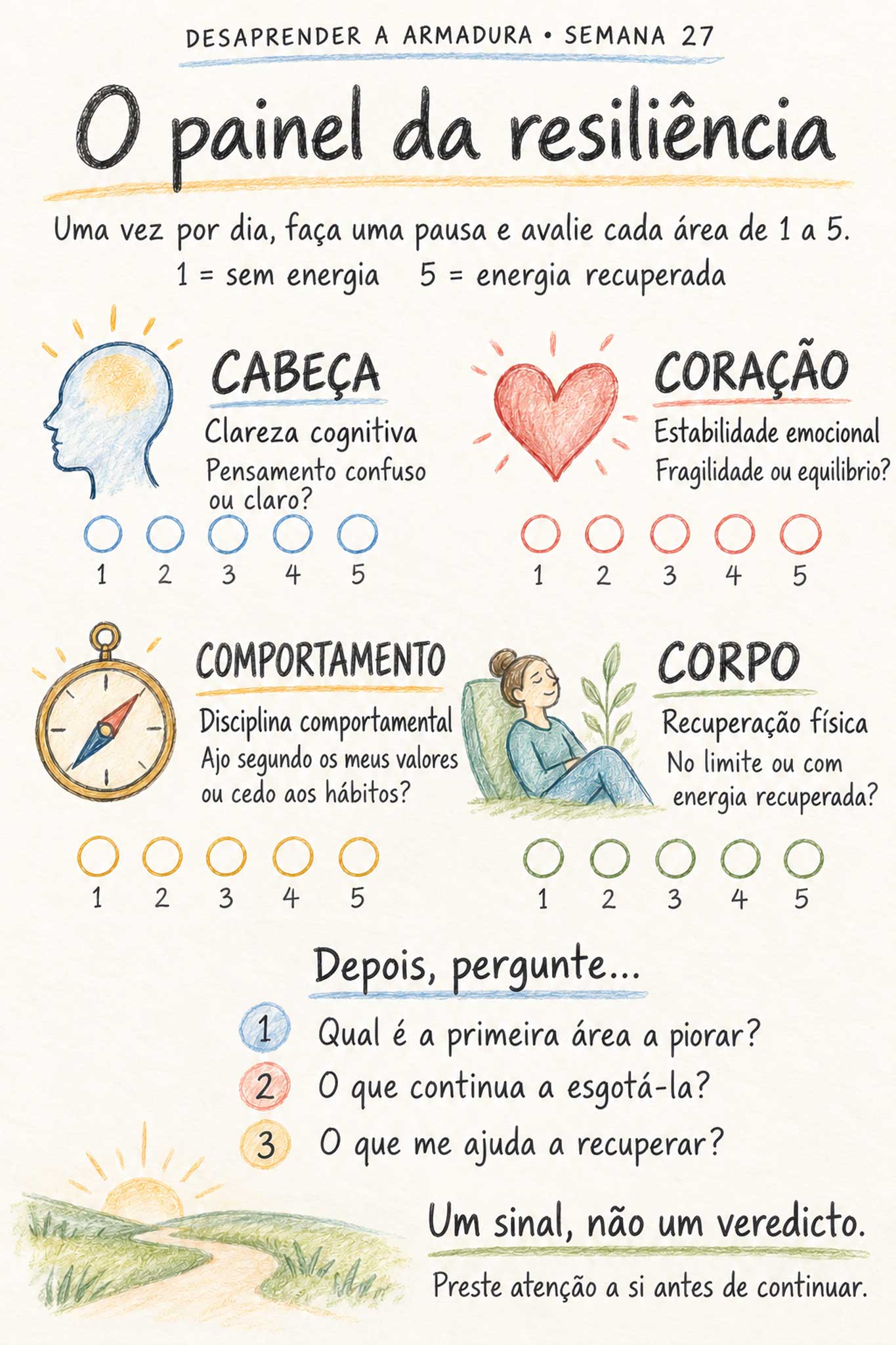
This week’s experiment: “The Resilience Dashboard”. Once a day, rate yourself 1 to 5 for head (clarity), heart (emotional steadiness), behaviour (acting from your values) and body (physical recovery). Then ask: which drops first, what keeps draining it, and what helps you recover?
This isn’t an argument for fragility, and pressure can build strength. Healthy resilience sits between the individual asking what restores them and the system asking what it expects people to absorb. Treat the score as a signal, not a verdict. Resilience says “return”; recovery says “grow”.
Listen to the full episode below.
- Details
- Written by: Dr Toomas Särev
A versão em português do cartaz desta semana está disponível aqui.
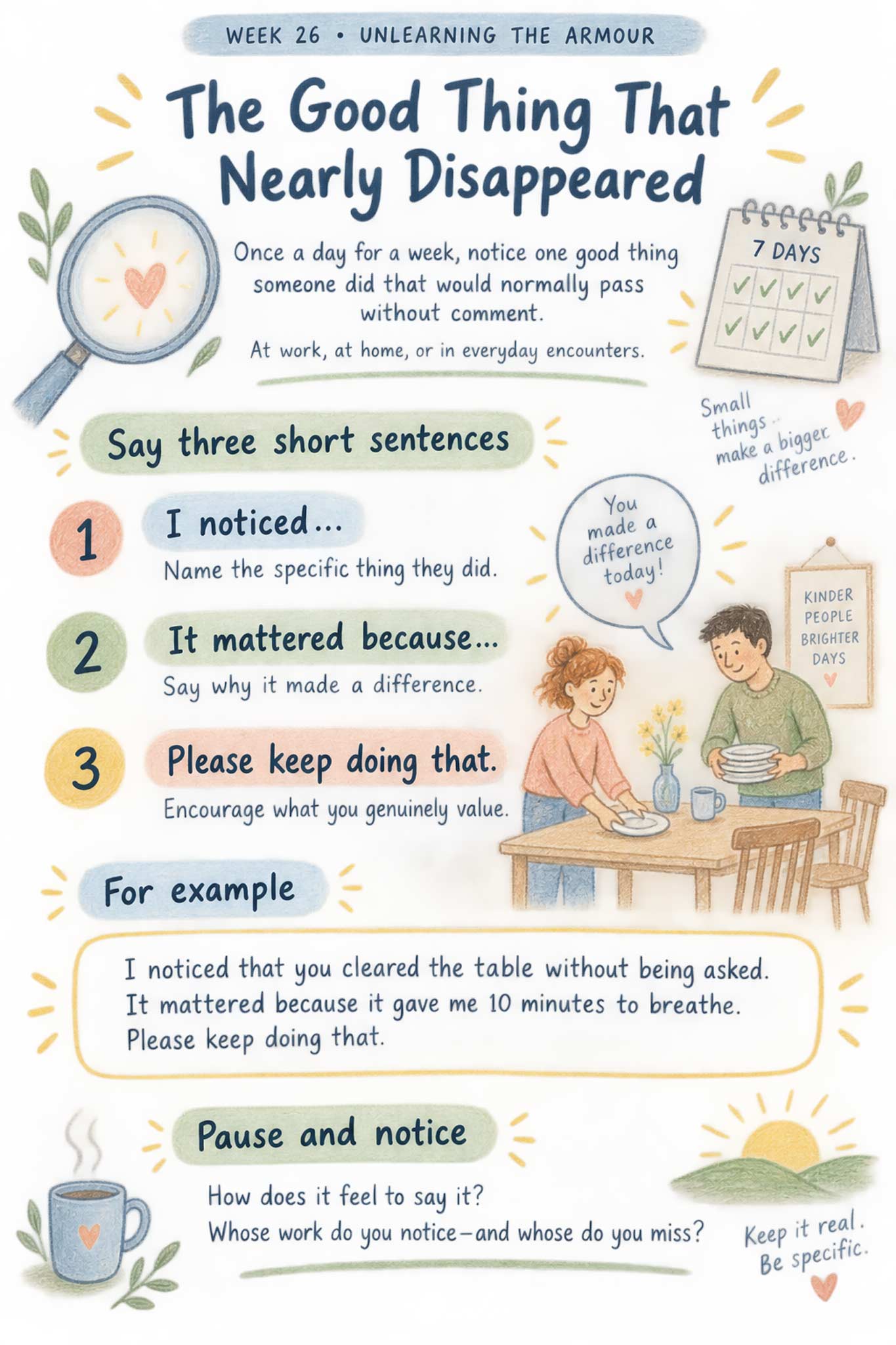 Dr Sarah Flindall and Dr Toomas Särev close the relational quarter with something that sounds almost like an afterthought: appreciation. Toomas's title, "The Silence After Something Good", names a particular silence that follows good work. It sets off no alarms, and nobody complains about it. A junior doctor spots a patient deteriorating before the numbers show it. A nurse sees fear in a patient's face and slows the conversation down. A receptionist absorbs someone's distress before it reaches the department. The day becomes safer and calmer because somebody did something human and skilful, and then the day simply moves on. Healthcare is good at investigating what goes wrong but far less practised at noticing what quietly stopped the problem, because the evidence for prevention is absence. Yet recognition is more than kindness; it is also instruction. It tells a person "what you did mattered, do more of that" and tells the team what good looks like. Toomas calls it social oxygen: being accurately seen, not flattered. "Well done" evaporates, but "You called early when the pattern wasn't obvious yet, and that's why we avoided something much worse" lands. A ten-second sentence like that can teach more than an hour-long appraisal.
Every team and family has an attention economy, and people quickly learn what gets noticed and give you more of it. If only mistakes are noticed, people become defensive. If the person who stays late every night is called committed while the person who sets a healthy boundary is quietly judged, we shouldn't be surprised when people burn out to applause. Not all praise is oxygen; some is anaesthetic, thanking people for surviving things that should have been fixed. The Red Team question is: what behaviour are we accidentally reinforcing? Claire, Toomas's co-author, writes about the quietly brilliant person every ward has: the one who sees what the shift needs before anyone asks and doesn't chase credit, and who often disappears into their own reliability as a result. A healthy culture notices quiet brilliance, and one sentence like "You saw what was needed before the rest of us did" can change how that person carries themselves. The same applies at home. Telling a teenager "I noticed you came back downstairs and apologised to your sister, and that took maturity" tells them something about who they are. A partner carrying the invisible work of the household may need one true sentence rather than a speech. For older people, whose lives can narrow to tablets, appointments and safety, recognition becomes a kind of dignity: a reminder that they are still a carrier of wisdom, humour and memory, not only someone being cared for.
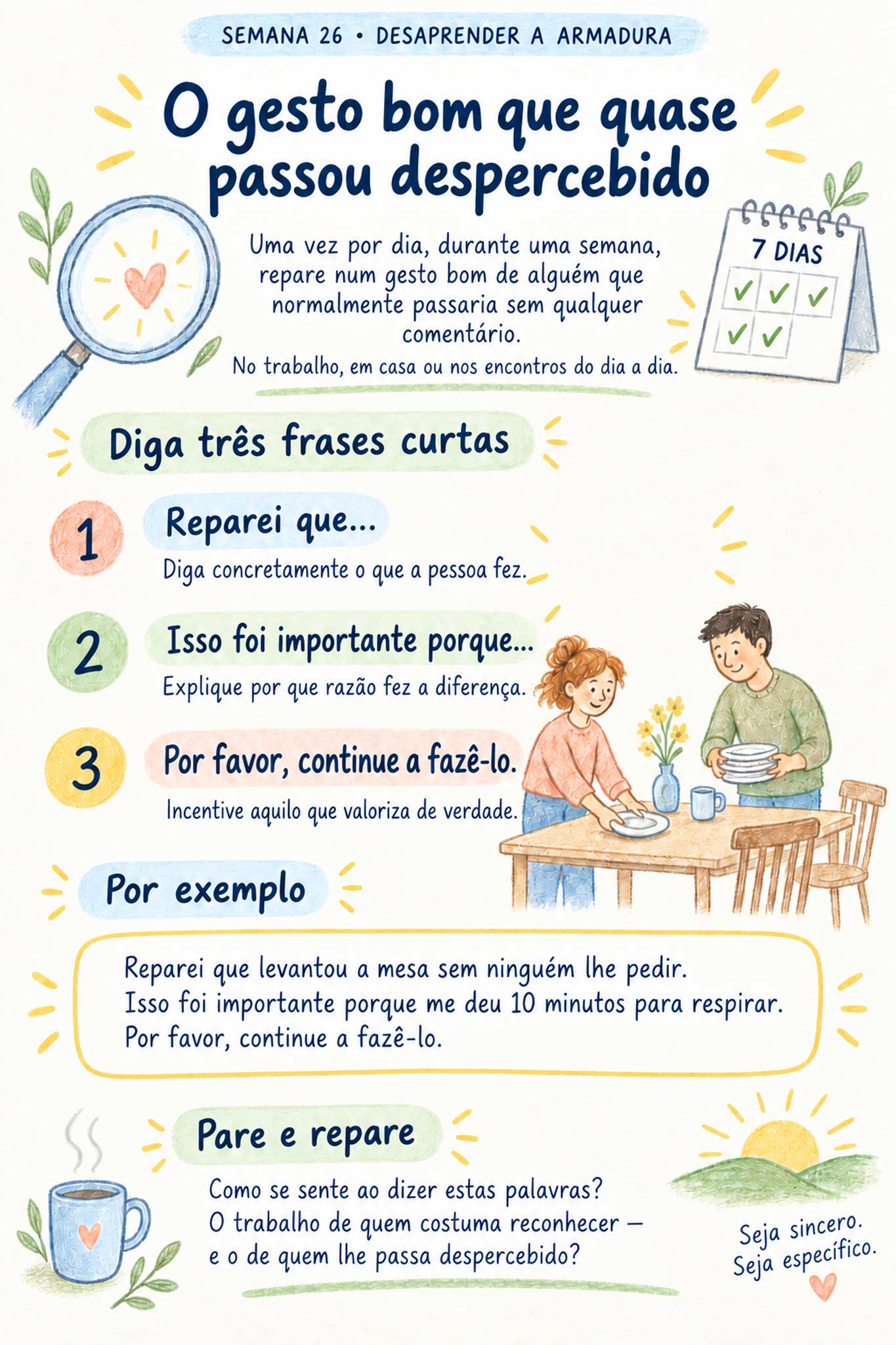
This week's experiment: "The Good Thing That Nearly Disappeared". Once a day for a week, look for one good thing someone did that would normally pass without comment, at work, at home or in an everyday encounter. Then say three short sentences: "I noticed… It mattered because… Please keep doing that." For example: "I noticed that you cleared the table without being asked. It mattered because it gave me ten minutes to breathe. Please keep doing that." While you do it, notice how it feels to say it, and notice whose work you find easy to recognise and whose you keep missing.
Everyone has an exquisite radar for fake positivity, so if recognition starts to feel like a technique, it loses everything. Keep it real and keep it specific. Many of us get awkward and brush appreciation off or turn it into a joke, so stay with the discomfort rather than softening the words. The experiment is also a mirror: it asks what your attention has been trained to see, and what it has been trained to ignore. If you are the one doing the invisible work that nobody notices, your work matters even when it is unnamed, but it shouldn't always stay unnamed. Sometimes the first step is to name it yourself, not as a complaint but as clarity, because invisible work becomes dangerous when everyone depends on it and nobody admits it exists.
Listen to the full episode below.
- Details
- Written by: Dr Toomas Särev
A versão em português do cartaz desta semana está disponível [aqui].
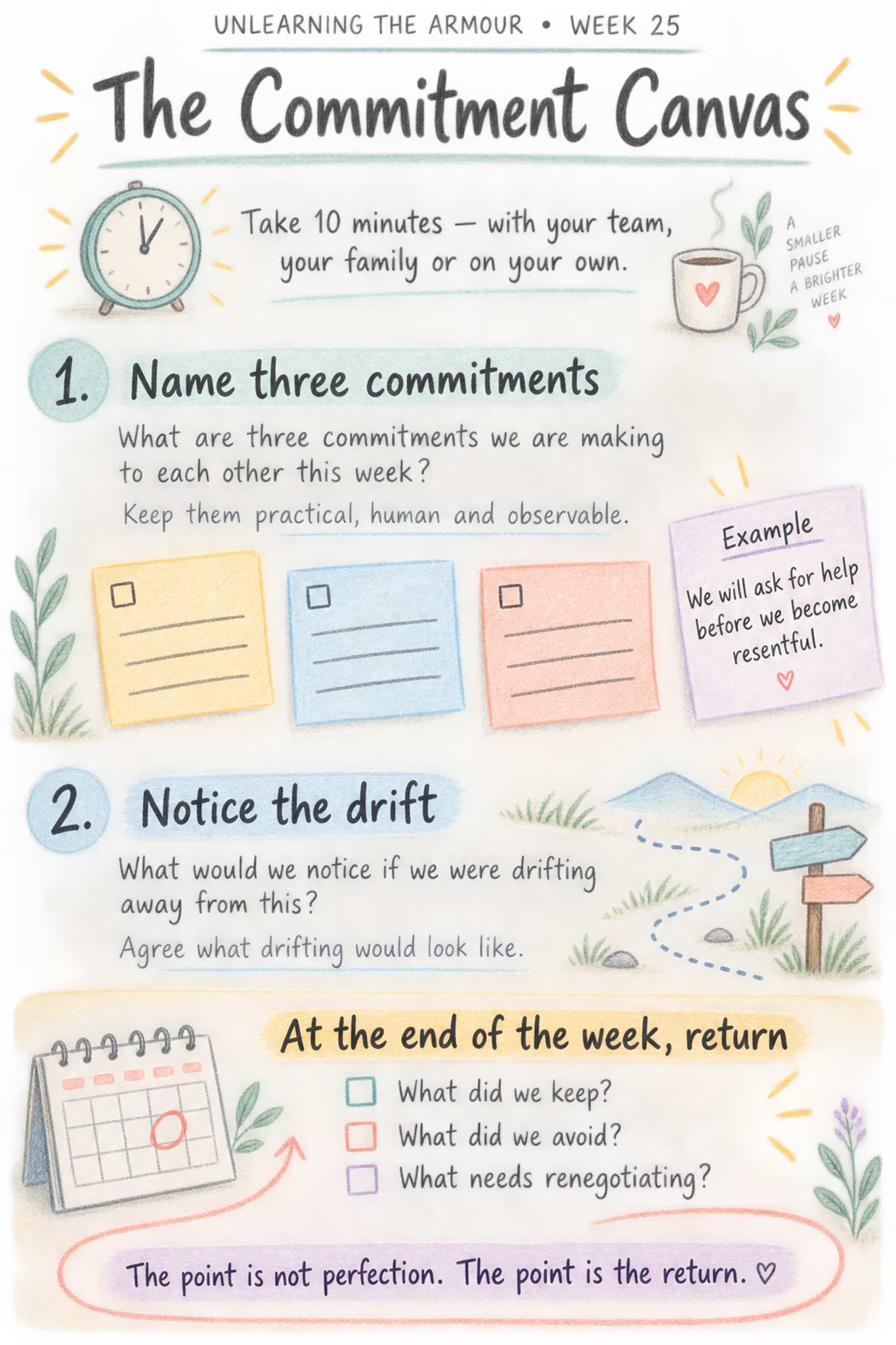 Week 25 of Unlearning the Armour picks up straight after blame: once we stop asking "who did it," a harder question appears — "what do we do now, and who owns it?" Dr Toomas and Dr Sarah spend the episode rescuing accountability from the word it's usually confused with. Blame looks backwards and asks who's at fault; accountability looks forwards and asks what needs to happen; and a third word, stewardship, asks what we're protecting for the future. The title comes from a simple, uncomfortable truth: people who look competent keep looking competent long after they've started struggling, and because they look fine, nobody asks. Toomas brings it onto the ward — patients don't experience departments, they experience one illness, and the gap between fragments is where harm lives — while Claire's nursing lens offers the kindest form of accountability: noticing the colleague who's gone quiet before anything breaks. From there the conversation widens to teenagers, invisible labour at home, and ageing parents who say "I'm fine" when they mean something else entirely — each one showing accountability with warmth, not blame in a smarter suit.
This week's experiment: the Commitment Canvas. Take ten minutes, alone or with your team or family, and answer two questions. First: what are three commitments we're making to each other this week — kept practical and observable, like "we'll close the loop when we say we will." Second, the one that does the real work: what would we notice if we were drifting away from this? At the end of the week, come back and check three things — what did we keep, what did we avoid, what needs renegotiating. The point isn't perfection. As Toomas puts it, accountability becomes real when we come back to what we said mattered.
Listen to the full episode below.
- Details
- Written by: Dr Toomas Särev
A versão em português do cartaz desta semana está disponível aqui.
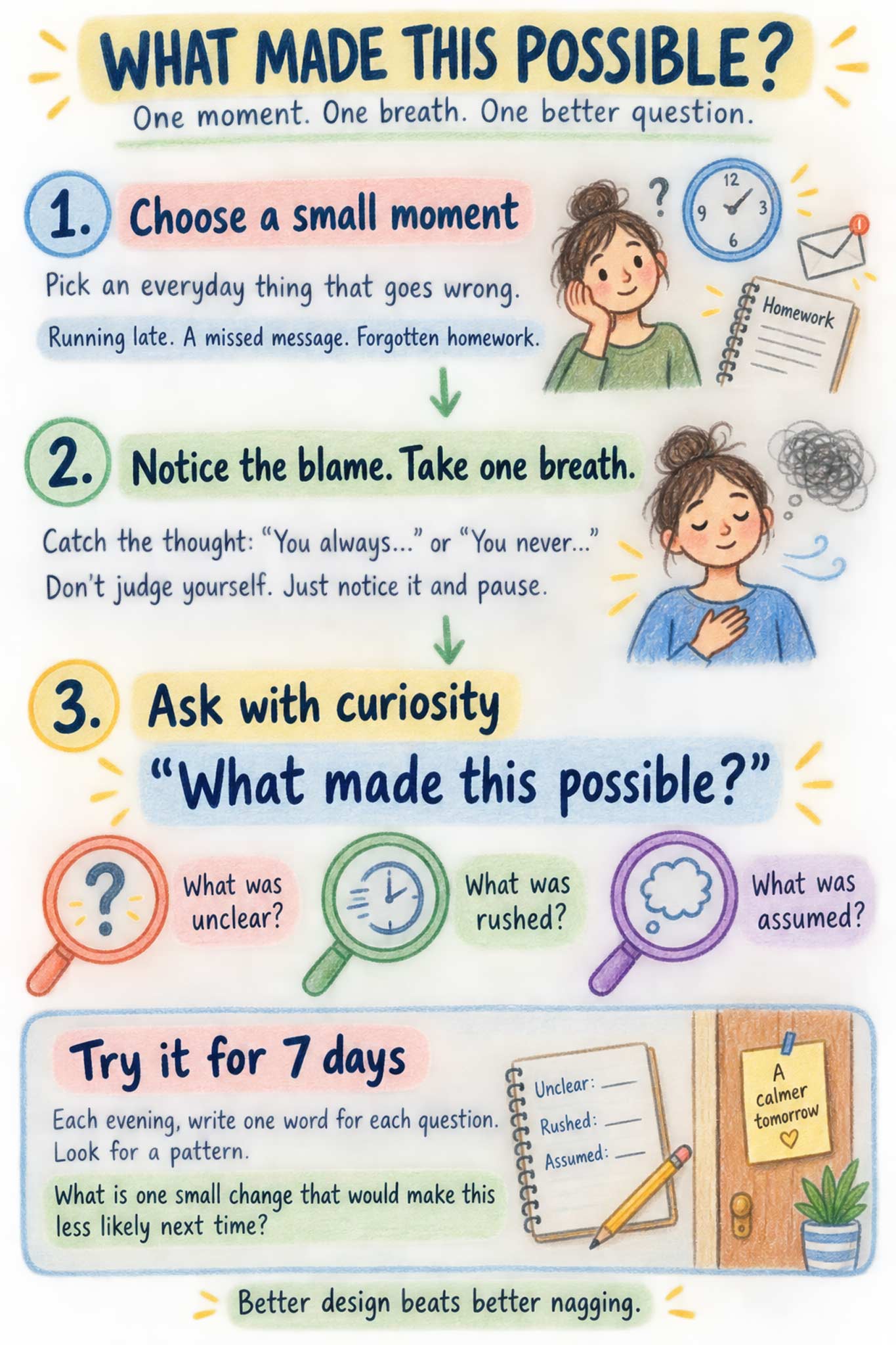 Deep into the relational quarter, Dr Sarah Flindall and Dr Toomas Särev turn to one of the fastest reflexes any of us have: blame. Something goes wrong, and almost at once the question becomes "Who did it? Who forgot? Who left the door open?" With exam season under way, winter pressure building in the NHS and families juggling work, money and care, the blame reflex rises with the pressure. Toomas describes blame as an emotional painkiller. It gives an uncertain room a tidy story and somewhere to put the discomfort, and for a moment everyone breathes out. But painkillers are not diagnostics. Blame quietens the pain without explaining it, and it stops the thinking far too early. The cost is a child who becomes ashamed instead of curious, or a team that goes quieter rather than safer.
The shift they explore is from a person to a pattern. Using a missed scan result in a busy clinic as an example, Toomas shows how one interruption, one assumption or one short-staffed afternoon can let something slip. A process that relies on one tired person remembering everything is an unsafe process, because good systems don't rely on perfect people. The same shape turns up at home. A teenager's "I forgot" is heard as "I don't care". An argument about housework becomes an argument about character. An older parent's missed medication becomes "you're being stubborn" when the real worry is fear. None of this means nobody is responsible. Blame looks backwards and asks whose fault it is, while accountability looks forward and asks what happened, what needs repairing and who owns the next step. Toomas offers one sentence for any kitchen table, staff room or ward: "Before we blame, can we understand what made this more likely?"
This week's experiment: "What made this possible?" Choose one small, ordinary moment when something goes wrong, such as someone running late, a missed message or forgotten homework. Notice the blame sentence that wants to come out ("You always…", "You never…") without judging yourself for it, and take one breath. Then ask "What made this possible?" and look for three things: what was unclear, what was rushed and what was assumed. Each evening for seven days, write one word for each and look for a pattern. To go further, ask what one small change would make it less likely next time, such as a note by the door, a shared list or a five-minute family reset. Better design beats better nagging.
This isn't about letting people off the hook. Responsibility still matters, and so do boundaries. Where someone's safety is at risk, deal with that first and ask the curious question afterwards. The experiment applies when the blame is aimed at yourself too: the point is to understand, not to find a new stick. As Toomas puts it, blame protects us from discomfort, but curiosity protects us from repetition.
Listen to the full episode below.
- Details
- Written by: Dr Toomas Särev
A versão em português do cartaz desta semana, sobre a porta aberta que ninguém atravessa e sobre o corredor que é preciso percorrer para lá chegar, está disponível aqui.
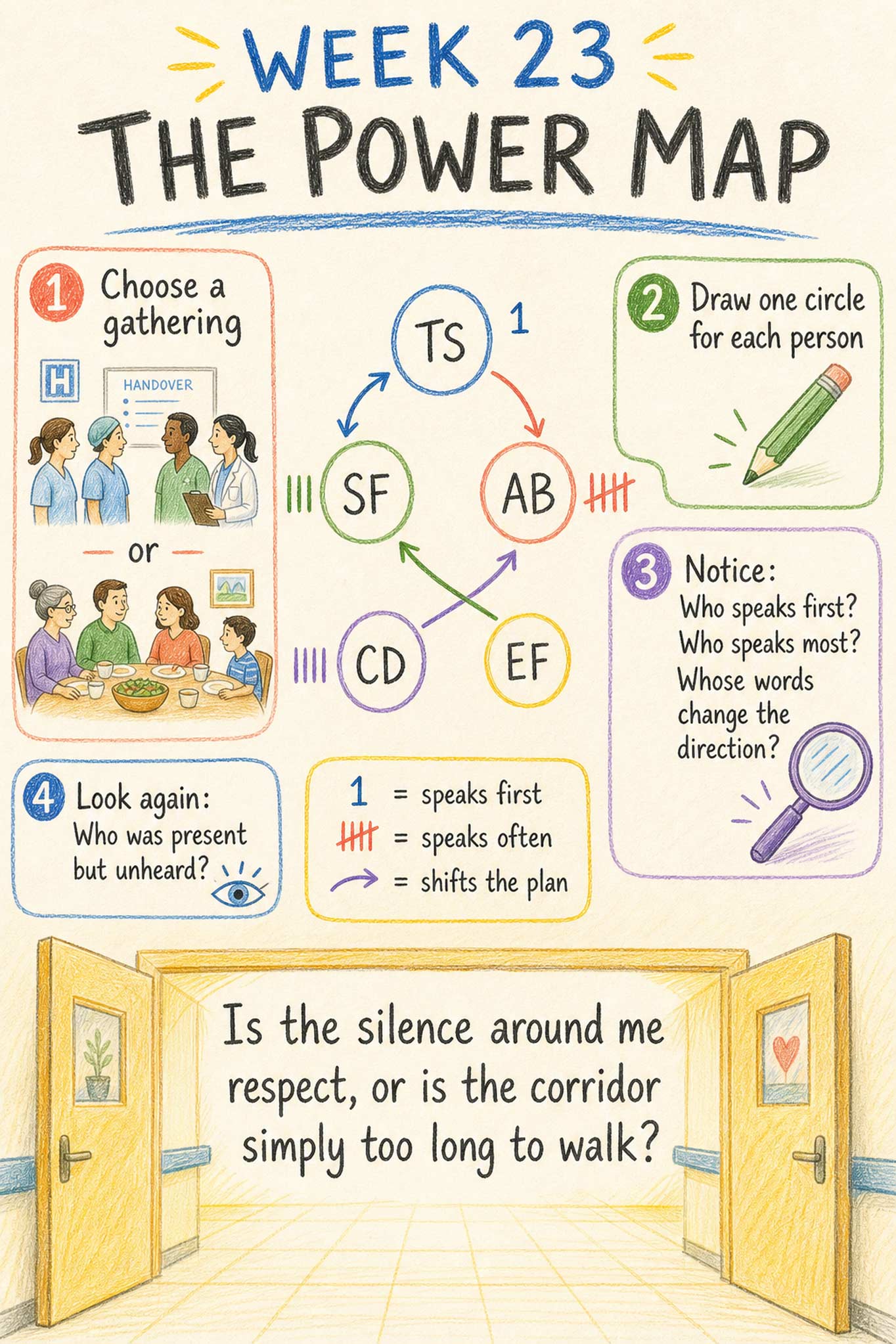 Week 23 of Unlearning the Armour starts with a sentence almost every leader has said: "my door is always open." Nothing is wrong with it — it's sincere, it's kind, and it's often useless, because the door was never the problem. Dr Toomas and Dr Sarah look instead at the corridor: everything a person has to walk through to reach that open door, built from hierarchy, memory, and the look on someone's face the last time a concern was raised. A consultant says it and means please come. A junior hears you may enter, but you will carry the cost. There are two kinds of power in any room — the kind printed on the badge, which you can draw on an organisational chart, and the kind you can only feel: who gets interrupted, whose idea lands only when someone senior repeats it, whose silence reads as wisdom and whose reads as not pulling their weight. Toomas is fair to authority — in a cardiac arrest you need one clear leader, not a committee — but authority without awareness extracts compliance and mistakes it for agreement. There's a hard story here from Claire, about a warm poster on the wall, one nurse who believed it, and what the whole unit learnt when she came back and handed in her notice. The poster stayed up. Nobody else walked through that door.
This week's experiment: the Power Map. Take one gathering — a board round, a handover, a family meal — and draw a small circle for each person. Notice three things as it unfolds: who speaks first, who speaks most, and whose words actually change the direction. Number the first speaker, tally the rest, and draw an arrow whenever someone's contribution shifts the plan. Then look at who has nothing beside their circle — present in the room, absent from the conversation. And if the arrows all come from you, there's one more question: is the silence around me respect, or is the corridor simply too long to walk? Toomas leaves us with the reason it matters. If the truth can't reach you early, it reaches you late — as a complaint, an incident or a resignation. It always arrives; the only question is whether it arrives in time to be useful.
Listen to the full episode below.
- Details
- Written by: Dr Toomas Särev
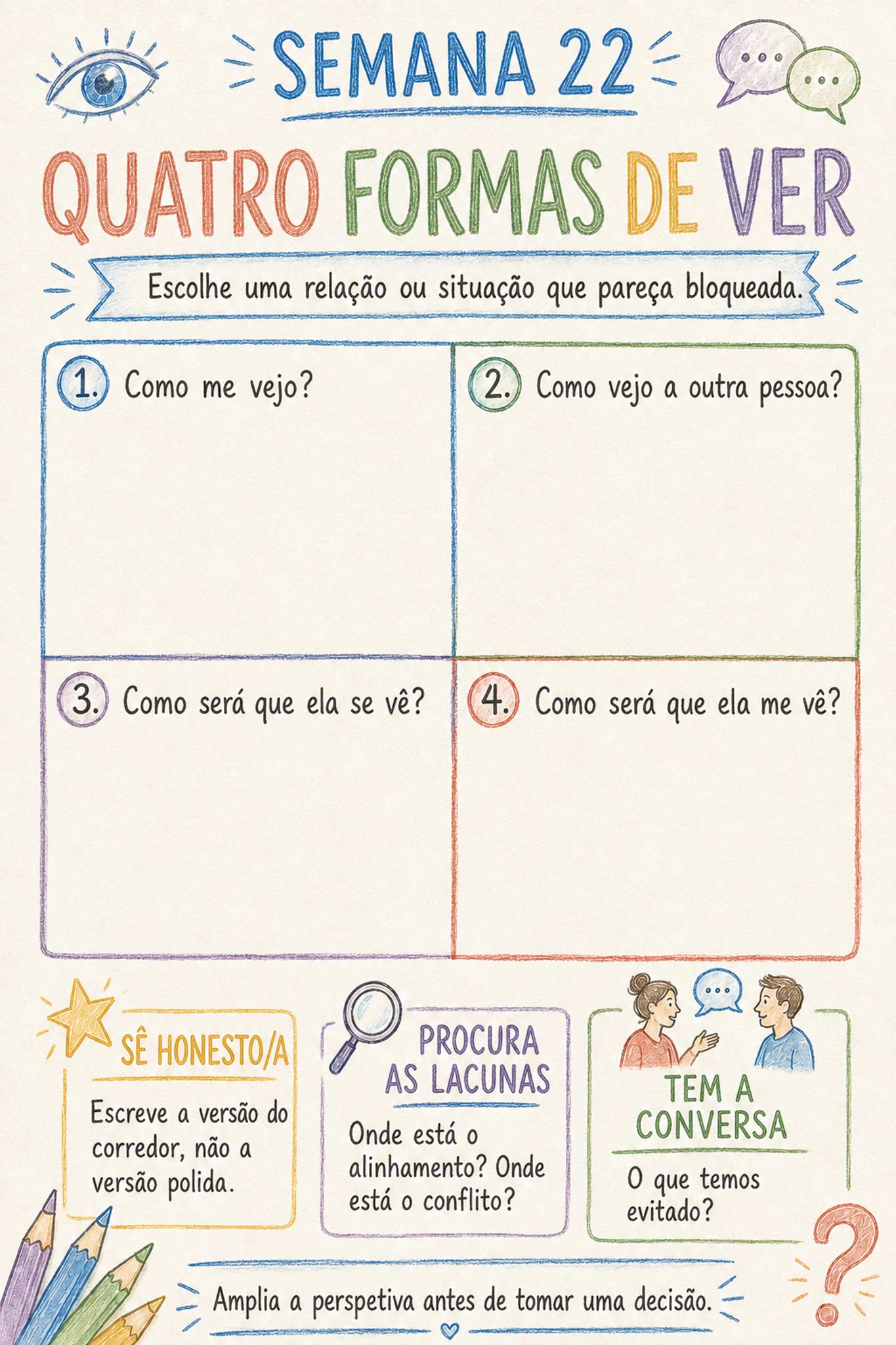
A versão em português do cartaz desta semana, sobre o acordo que na verdade é alívio e sobre as quatro maneiras de ver a mesma situação, está disponível aqui.
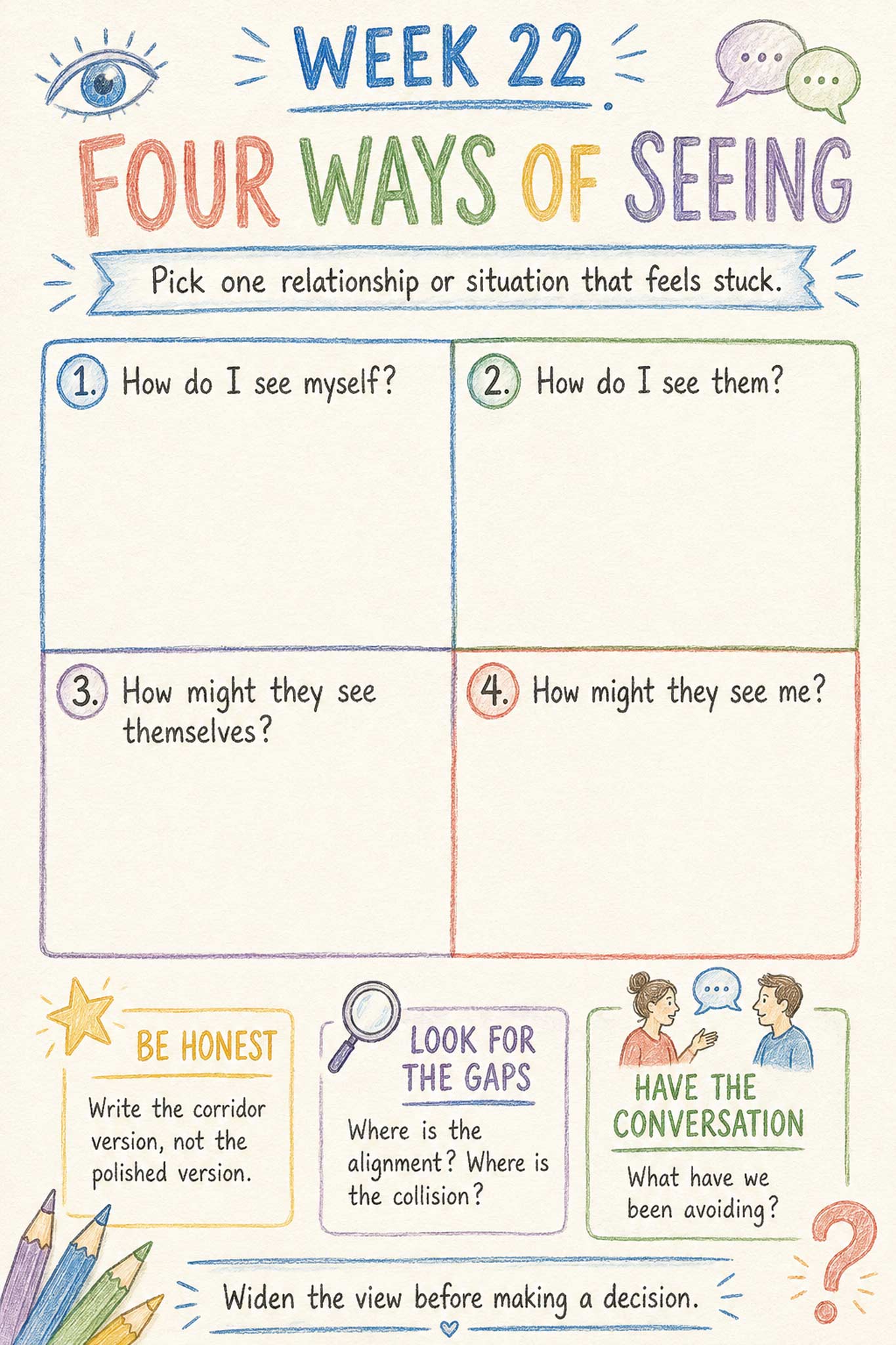 Week 22 of Unlearning the Armour goes somewhere uncomfortable: agreement usually looks like progress, and almost always feels like relief — but it isn't always either. Dr Toomas and Dr Sarah look at the rooms where everyone appears to agree — the ward round, the board meeting, the discharge discussion. Nobody is silenced. Someone senior frames the issue, a few people add detail, the room senses where the decision is going, and the conversation quietly narrows. What looks like consensus may just be the social success of the first confident version of events. Sometimes it was relief, sometimes exhaustion, sometimes hierarchy, sometimes a quiet decision that speaking up wasn't worth the emotional cost. Sarah takes it out of the meeting room and into the consultation: the polite "yes, doctor" from someone who has ten tonnes of untaken tablets at home, and who will eventually stop coming altogether. Intelligence lost politely, as she puts it. Teams under pressure don't sort information by relevance, they sort it by status — and the patient's body doesn't care who has the higher banding.
This week's experiment: Four Ways of Seeing. Pick one relationship or situation that feels stuck, and draw a simple two-by-two grid. How do I see myself here? How do I see them? How might they see themselves? And the hard one — how might they see me? Write the corridor version, not the polished one; sugar-coating makes the exercise worthless. Then look at the boxes and ask where the alignment is, where the collision is, and where the conversation is that you've been avoiding. A plan nobody questioned isn't a strong plan. Reality will test it anyway.
Listen to the full episode below.
- Details
- Written by: Dr Toomas Särev
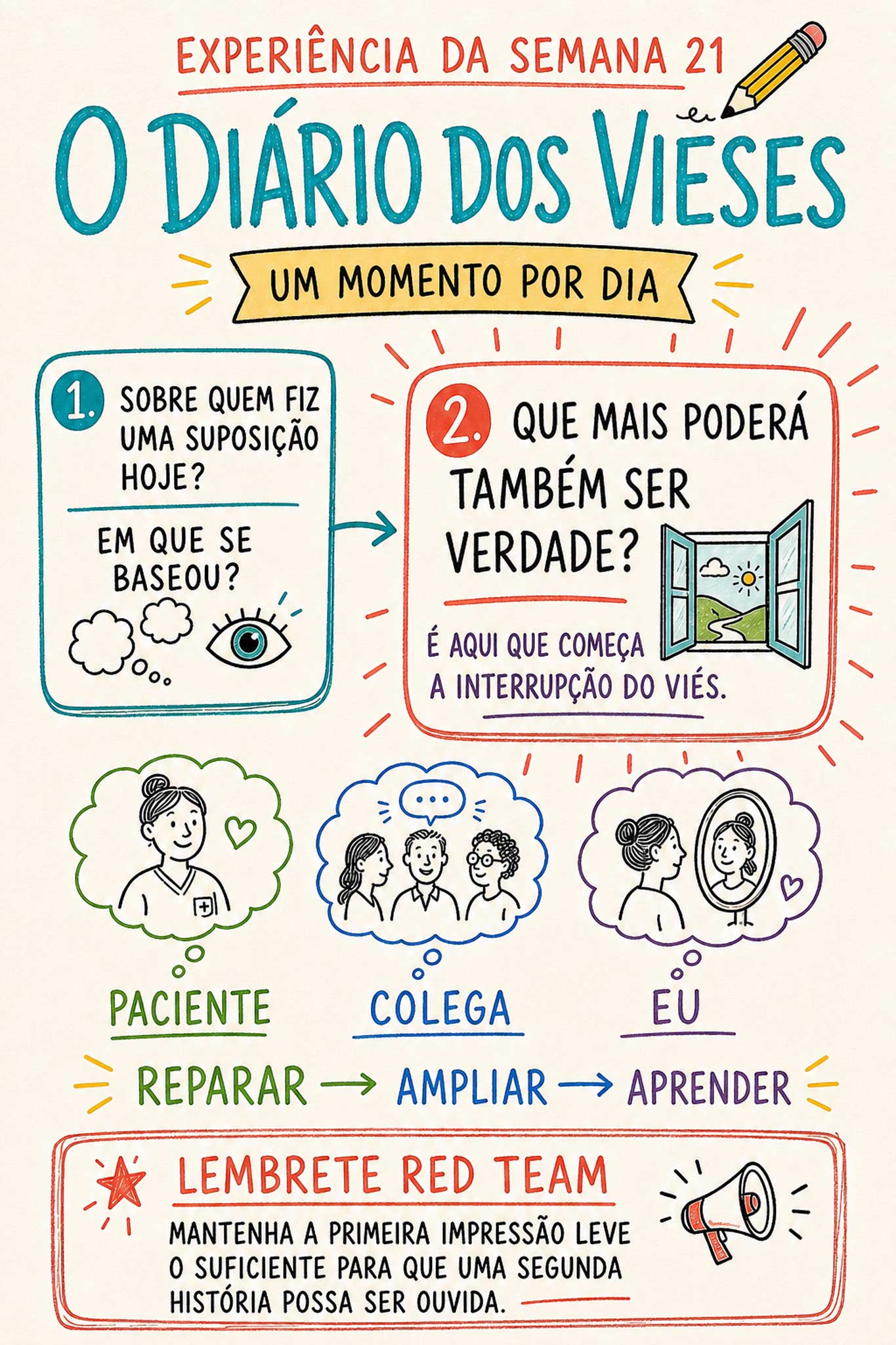
A versão em português do cartaz desta semana, sobre a história que chega antes das provas e sobre perguntar o que mais poderá ser verdade, está disponível aqui.
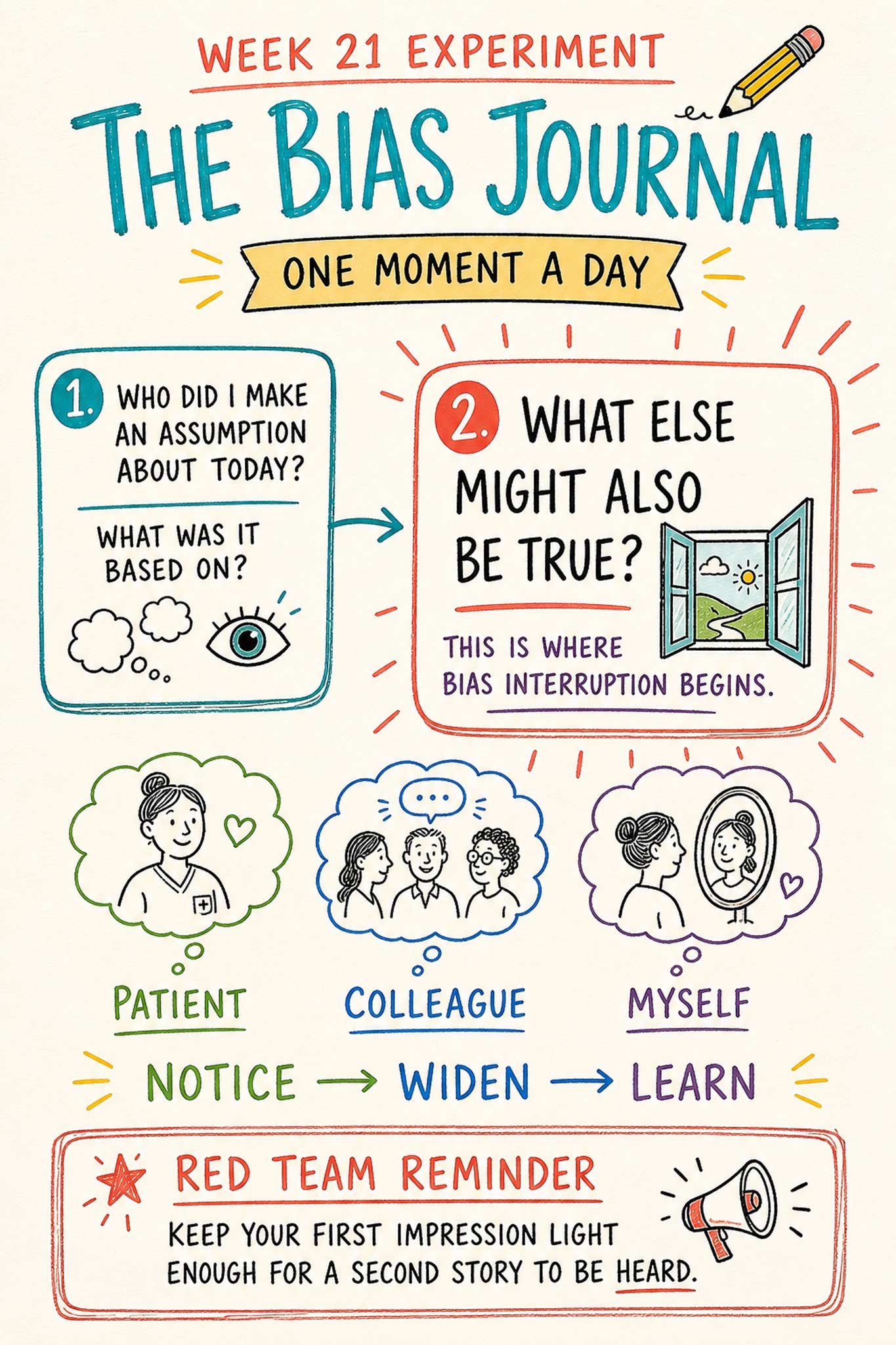 Week 21 of Unlearning the Armour goes to something that happens before a conversation ever begins. You read three lines of a referral and something shifts — your jaw tightens, your curiosity narrows. You haven't met the person yet and you haven't asked a single question, but the story is already running, and when they walk through the door they aren't only bringing their symptoms: they're having to walk through the version of themselves you've already written. Dr Toomas and Dr Sarah are careful not to treat this as a moral failing. Healthcare runs on pattern recognition — one second with an ECG and you know. The trouble is that shortcuts don't announce themselves. They feel like experience, like common sense, like intuition. The conversation ranges from the tired registrar called at two in the morning, to who gets described as lovely on the ward round and who gets described as hard work at handover, to the older patient labelled confused who may simply be dehydrated, or frightened, or ashamed to admit they didn't understand the words.
This week's experiment: The Bias Journal. At the end of each day, write one short entry around two questions. Who did I make an assumption about today, and what was it based on? And then — this is where the whole practice lives — what else might also be true? The aim was never to become bias-free. It's to be less captured by the first story the mind tells us. Sometimes that story is right, but it still has to earn its place rather than win because it arrived first.
Listen to the full episode below.
- Details
- Written by: Dr Toomas Särev
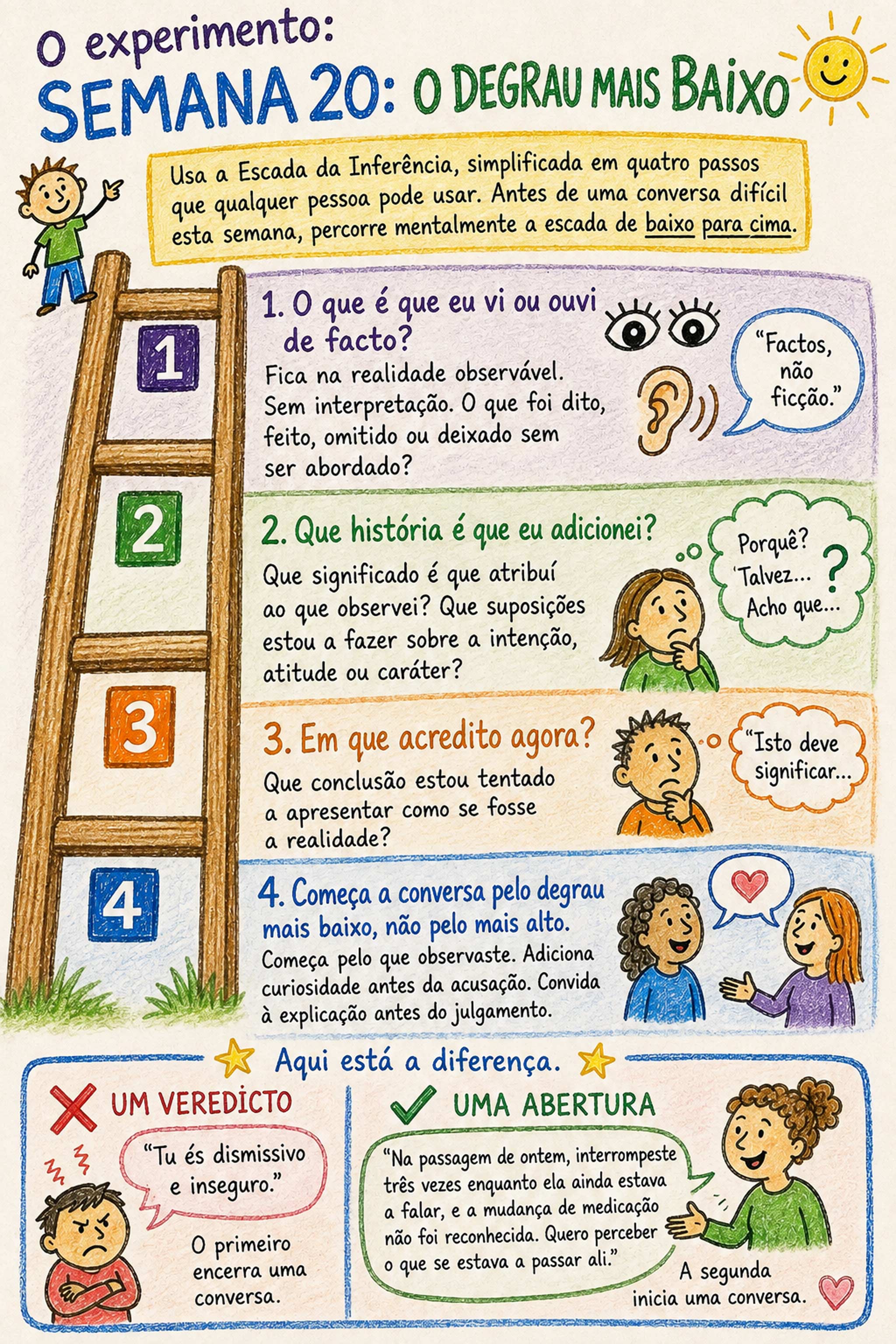
A versão em português do cartaz desta semana, sobre como voltar ao degrau mais baixo da Escada da Inferência antes de uma conversa difícil, está disponível aqui.
 The conversation you keep postponing does not disappear. It gathers weight.

We often tell ourselves we are waiting for the right moment.
We are being patient. Professional. Kind. We do not want to make things worse.
Sometimes that is wise. Sometimes it is avoidance wearing respectable clothes.
The difficulty is that an unspoken concern rarely stays neutral. While we wait, we add interpretation, frustration and private narrative. What began as one observable event slowly becomes a judgement about somebody’s attitude, competence or character.
In Cognitive Oxygen® terms, avoidance creates a slow social oxygen leak. Everyone can feel that something is wrong, yet nobody has given it language.
And silence has consequences.
In healthcare, a consultant may delay speaking to a trainee because they want to be supportive. A nurse may notice a colleague cutting corners and say nothing because everyone is already stretched. A manager may sense growing tension and hope the team will sort it out themselves.
- Details
- Written by: Dr Toomas Särev

A versão em português do cartaz desta semana está disponível aqui.
Week 19 of Unlearning the Armour turns to a problem every clinician, parent and manager eventually meets: the sentence was correct, and the room still went cold. Dr Toomas and Dr Sarah look at why accuracy and connection aren't the same thing. Accuracy is the skeleton of a conversation; connection is the circulation. Without it, even correct information can arrive as frightening, cold or simply unusable — a family sitting in silence after a resuscitation conversation, having heard everything and understood almost nothing that matters. It happens with teenagers told to take their future seriously, with elderly parents told they're "medically fit for discharge," with colleagues told they're wrong. The words may all be accurate. Any of them can land like a door closing.
Toomas and Sarah trace this through the ward round — the consultant who says "just tell me what you want" versus the one who asks "tell me what you're most worried about" — and out into everyday life: teenagers listening for whether an adult sees anything good in them underneath the correction, parents who go sharp or vague when they're depleted rather than badly intentioned, and older people spoken around rather than to, where "you need a package of care" can be heard as "you're becoming a burden."
- Details
- Written by: Dr Toomas Särev
A versão em português do cartaz desta semana está disponível aqui.
 This week Dr Sarah and Dr Toomas ask how self-awareness actually grows — and why it's rarely a private achievement. Most of the time it grows in the space between people: when someone notices something and stays curious instead of judging. A spotlight says "here is what you did wrong — now fix it". A mirror says "here is what I see — what do you make of it?" One creates heat; the other creates space, and space is where self-awareness begins.
Toomas explains why being told "you need to be more self-aware" almost always triggers defensiveness, and why depletion — tiredness, overload, loneliness — quietly narrows our ability to see ourselves clearly. Sarah brings in the Johari Window: what we know about ourselves, what we hide, what others can see but we can't, and the unknown unknowns. They trace the mirror through the ward round — the registrar growing blunter under an unsafe workload, the senior nurse who simply says "I've noticed you don't quite seem yourself lately" — and out into everyday life: teenagers who don't yet have words for what's happening inside them, adults sleepwalking through busy lives, and older people whose hardening may be hiding losses that are difficult to name.
This week's experiment: The 3-Question Check-In. Once this week, after a moment of tension, try three questions: What happened? What was going on in you at the time? What do you want to do differently next time? Ask with genuine curiosity, don't rush to fill the silence, and don't turn every answer into advice. Three minutes is enough — and it works just as well asked of yourself.
One caution from Toomas: this should never feel like surveillance. People don't grow when they feel examined; they grow when they feel safe enough to tell the truth.
Listen to the full episode below.
- Details
- Written by: Dr Toomas Särev
Para visualizar o pôster desta semana em português, clique aqui: Semana 17: Pausa, Perspectiva, Resposta
 This week Dr. Toomas Särev brings us to the one quality that holds everything together — and the one no leader can fake for long: empathy. Not the soft, sentimental kind people sometimes dismiss as touchy-feely, but something far more demanding. As Toomas puts it, empathy is the courage to understand another person's reality well enough to respond wisely. Most empathy failures, he argues, are not failures of caring — they are failures of pace. We genuinely care, but we are tired, hurried, and overloaded, so we conclude too quickly and respond to the story in our own heads rather than the person in front of us. The brisk registrar may not be arrogant — they may be overloaded. The hesitant junior nurse may not be weak — they may simply be trying not to be humiliated in public. Empathy doesn't mean agreeing with every behaviour; it means refusing to flatten people to caricatures before you've listened for their whole story. This week's experiment is Pause, Perspective, Response — a seven-day practice in staying human under pressure. Before you reply, take one breath and if you need to, say out loud: "Give me a moment — I want to respond well." Then ask yourself two quiet questions: what else might be going on here, and what might this feel like from their side? Then, before you speak, ask one more: how do I tell the truth without stripping this person of dignity? Track it with one line each evening — today I paused before responding to... and what changed was... Try it once a day for seven days.
- Details
- Written by: Dr Toomas Särev
Para visualizar o pôster desta semana em português, clique aqui: Semana 16: A Pausa de Curiosidade de 90 Segundos.
 This week Dr. Toomas Särev turns our attention to curiosity — not as a personal trait, but as a clinical and leadership skill. He opens with a sharp observation: the moment a working diagnosis forms, everyone in the room relaxes, the plan sets, and curiosity becomes friction. The person who asks "but what if it's something else?" is no longer seen as contributing — they're slowing things down. When speed becomes identity, questions start to sound like delay, and teams learn without anyone saying it out loud that the safest contribution is the fastest familiar answer. But as Toomas reminds us, curiosity is how a team stays intelligent after the most senior person has spoken. This week's experiment is The 90-Second Curiosity Pause — four steps you can run through in your head before any decision closes: name the current plan, surface the hidden assumptions, explore what else might explain what you're seeing, then decide whether to stay with the plan or adjust it. Use it in a ward round, a meeting, a family conversation, or with your teenagers. Track it each evening with three words — what you asked, what surfaced, what shifted — and after seven days, look at the pattern. As Toomas puts it: curiosity is not the opposite of authority. It's the discipline that keeps authority from becoming arrogance.
The audio of this segement of Dr Sarah On Call.
- Details
- Written by: Dr Toomas Särev
Para visualizar o pôster desta semana em português, clique aqui: Semana 15: Dois Ouvidos, Uma Boca
This week Dr. Toomas Särev offers us the treatment for last week's diagnosis. If "fine" is the symptom, listening is the cure — but not the kind of listening where you wait for someone to finish so you can say what you were already thinking. As Toomas puts it, good people cause most of the conflict in healthcare, and they do it by talking too soon. The instinct to help is so strong that we rush to fix before we've truly understood, and the result is that people learn to give us the version of reality we can handle, rather than the real one. This week's experiment is Two Ears, One Mouth — honour the ratio. Pick one conversation where trust matters, listen twice as much as you speak, and use your words only to reflect back what you heard, clarify what you missed, or ask a genuinely curious question. When you run out of questions, use just three words: "And what else?" — ask it three times and sit in the silence, because that's often where trust is built. Save any advice for the last 60 seconds. As Toomas reminds us, the most precise instrument you own is not your clinical knowledge or your experience — it is your attention.
- Details
- Written by: Dr Toomas Särev
Para visualizar o pôster desta semana em português, clique aqui: Semana 14: O Check-in "Além do Tudo Bem
 This week we move into a new chapter of our series with Dr. Toomas Särev — from the inner world of leadership to the relational world. And we start with one small, familiar word: "fine". Fine sounds harmless, even polite. But as Toomas puts it, sometimes it's armour — code for "I don't feel safe enough to say what's really going on." Whether it's a teenager deflecting after a hard day at school, an adult hiding burnout, a colleague swallowing a concern, or an elderly parent masking fear as dignity, "fine" marks the exact point where connection stops being real and starts becoming performance. This week's experiment is The Five-Minute Beyond Fine Check-In — four simple questions you can try with a partner, a teenager, an elderly parent, a friend, or even yourself: What is one thing that is not fine, even if you've been calling it fine? What feels hard to say out loud? What would help this feel safer to talk about? And what is one small next step — not the perfect solution? No fixing, no cross-examining, no rushing to advice. Just making reality nameable. As Toomas reminds us: early truth is faster than late damage.
- Details
- Written by: Dr Toomas Särev
Para visualizar o pôster desta semana em português, clique aqui: Semana 13: A Verificação da Linha
 This week closes the first quarter of our series with Dr. Toomas Särev, and he brings us something he calls brutal optimism — two words that are deliberately uncomfortable together. It's not positive thinking, which asks you to look away from the problem. Brutal optimism asks you to look the problem straight in the eye — the sick calls, the understaffing, the pressure — see it clearly, without softening, and still choose to move toward what is achievable. The honesty is the brutal part; the direction you choose is the optimism. Together they produce something neither can do alone: movement. And as Toomas reminds us, leadership isn't about cheerfulness — it's about movement. The week's experiment is The Line Check: the next time you feel the weight of things winning, ask yourself just one question — "What is one thing within my actual authority that I can do in the next 10 minutes?" — and take that small step. One question. One action. That's enough to change direction.
- Details
- Written by: Dr Toomas Särev
 Para visualizar o pôster desta semana em português, clique aqui: Semana 12: O Diário de Reflexão de Fluxo
This week we explore The Flow Reflection Log — a simple end-of-day practice to help you notice what creates and breaks flow in your workday. By asking just three questions each evening — where did flow show up, what broke it, and what one micro-adjustment can you make tomorrow — you begin to build self-awareness about the conditions that help you do your best work. It doesn't need to be long or detailed; even one honest line a day can reveal patterns you'd never otherwise notice. Small observations lead to small changes, and small changes add up.
- Details
- Written by: Dr Toomas Särev
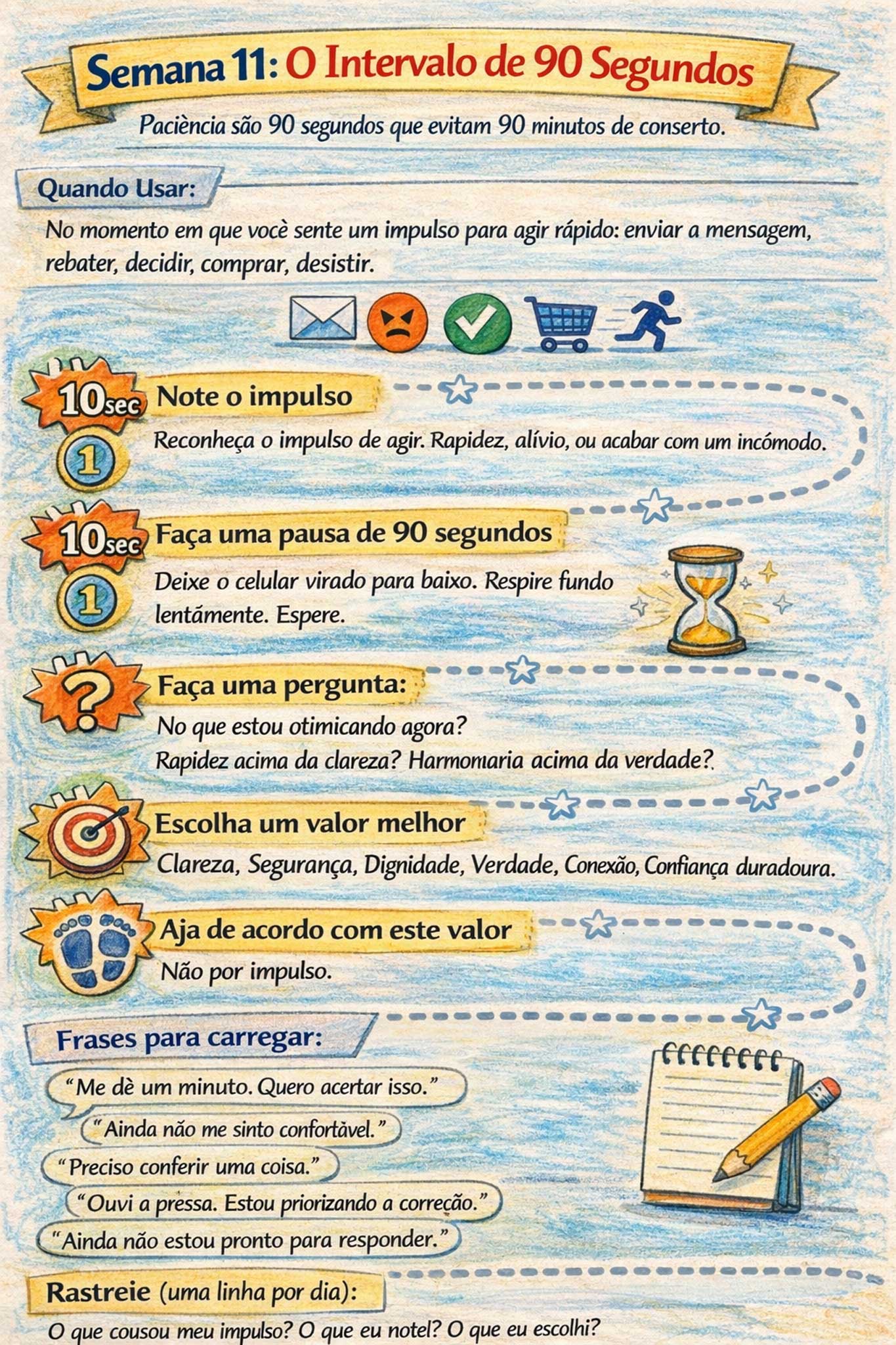
 Para visualizar o pôster desta semana em português, clique aqui: Semana 11: O Intervalo de 90 Segundos
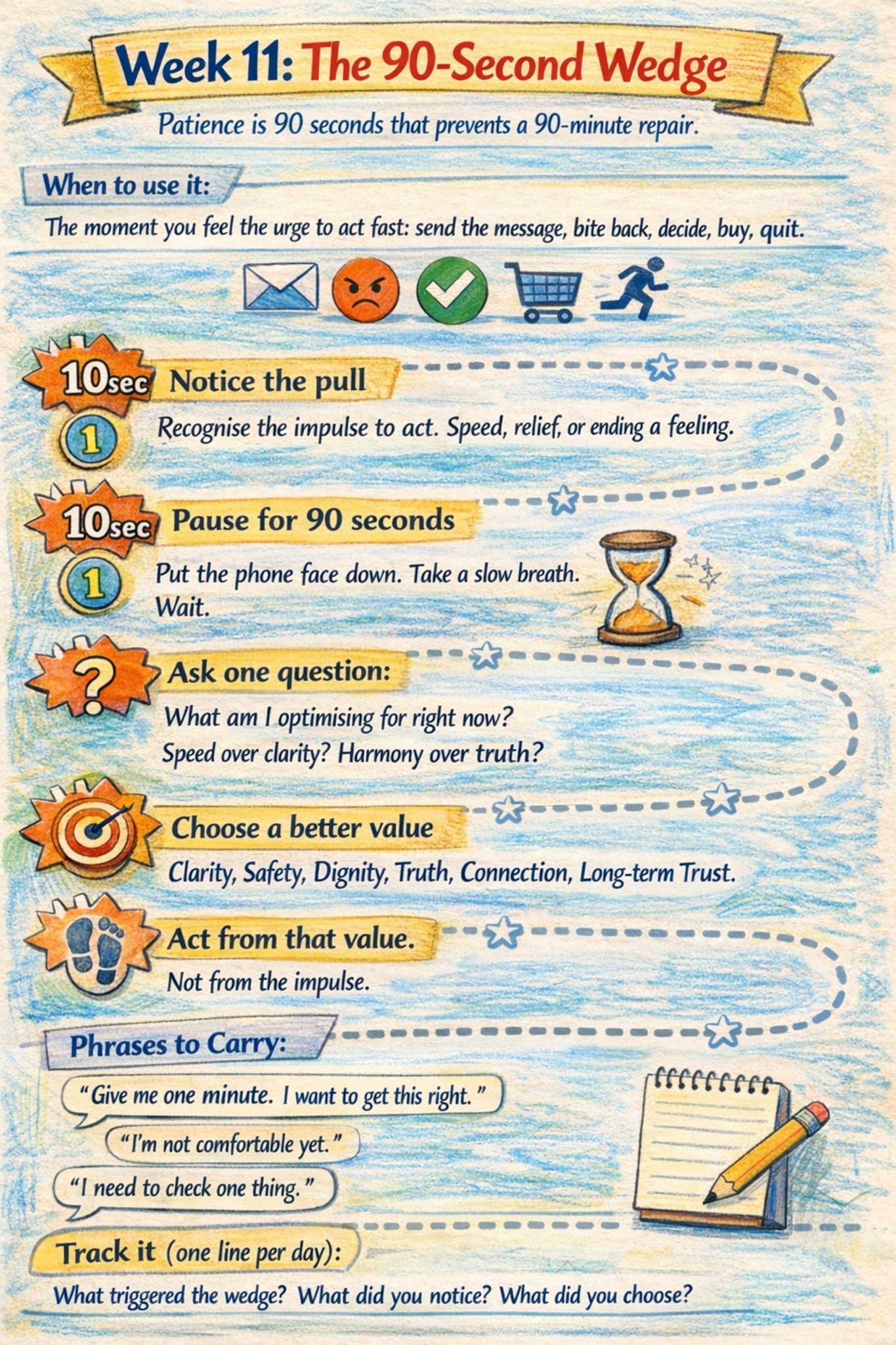
The 90-Second Wedge is where awareness becomes practice. Last week invited you to loosen your grip on certainty — to say “I don’t know yet” instead of rushing to conclusions. This week builds on that by interrupting something even faster: the urge to act. Because often, the problem isn’t what we think — it’s how quickly we move from feeling to doing. A message sent too soon, a reaction we can’t take back, a decision made just to relieve discomfort.
This practice creates a small but powerful gap between impulse and action. In those 90 seconds, nothing dramatic happens on the outside — but internally, everything can shift. You notice the pull, you pause, and you choose what actually matters instead of what feels urgent. Over time, this wedge becomes a kind of quiet strength: the ability to stay with discomfort just long enough to act with clarity, dignity, and intention — not just speed.
- Details
- Written by: Dr Toomas Särev
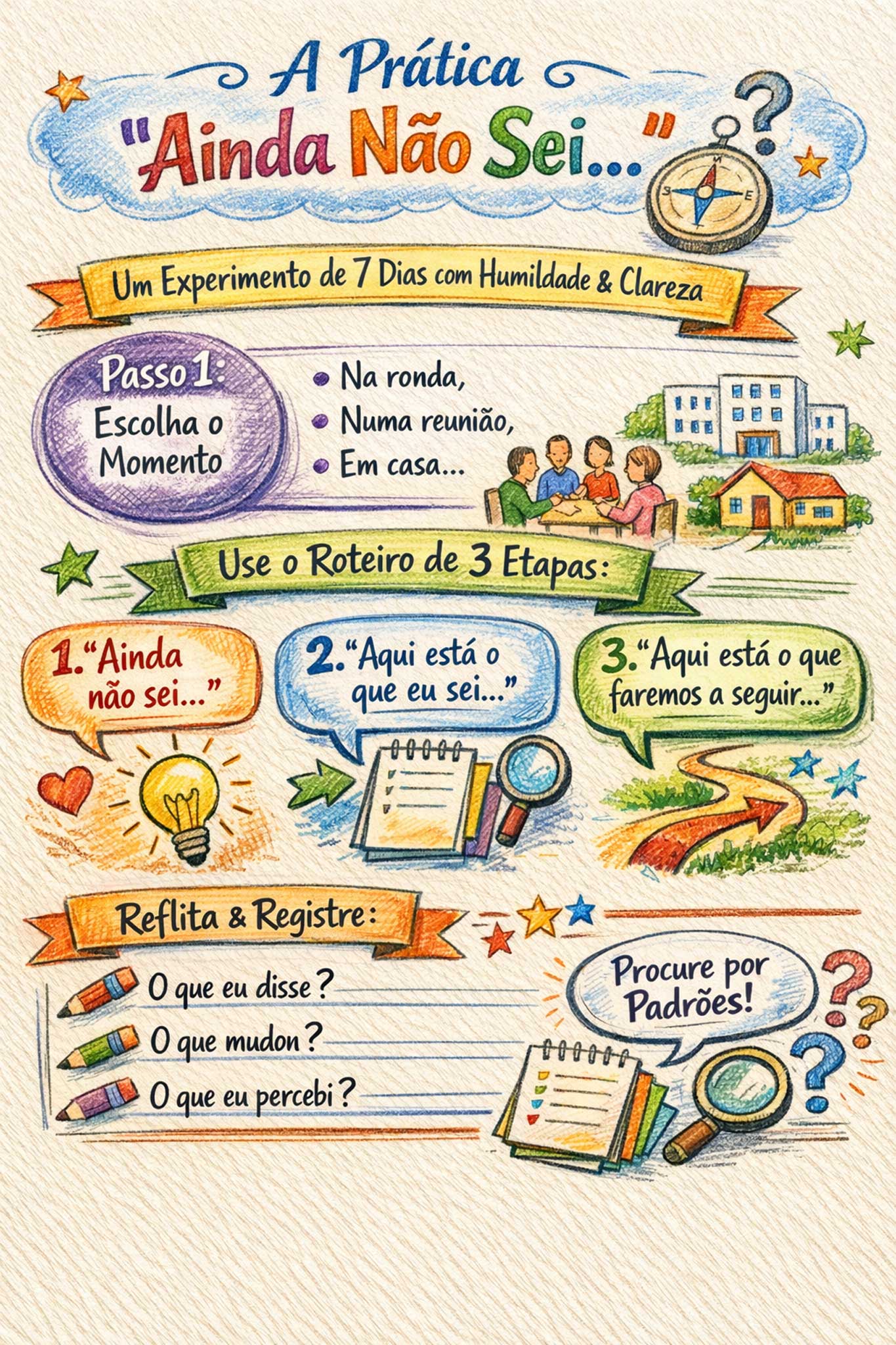
Certainty vs. Humility
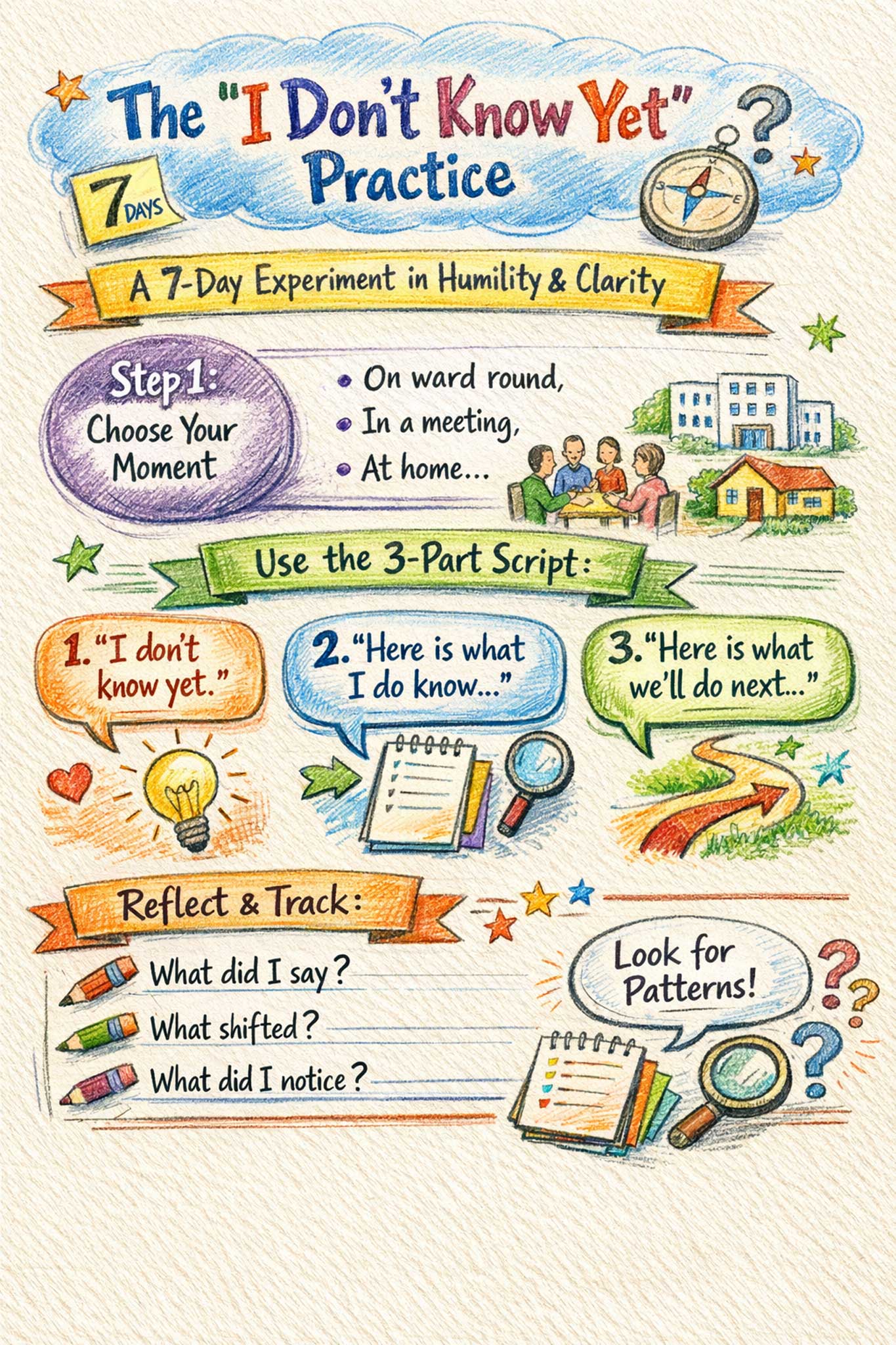 Para visualizar o pôster desta semana em português, clique aqui: [Semana 10: A Prática "Ainda Não Sei..."]
We often feel a crushing pressure to perform "certainty theatre"—a performance of total competence where we feel we must have every answer immediately. While common in professional life, this is equally draining at home and in schools; parents often feel they must project absolute authority, and teenagers face intense pressure to look like they are in total control of their lives. However, pretending to be certain when we are not is a "short-term loan" taken out against long-term trust. True humility is not weakness or a lack of expertise; it is the self-awareness to recognize the limits of that expertise so that others feel safe to contribute what they know.
- Details
- Written by: Dr Toomas Särev
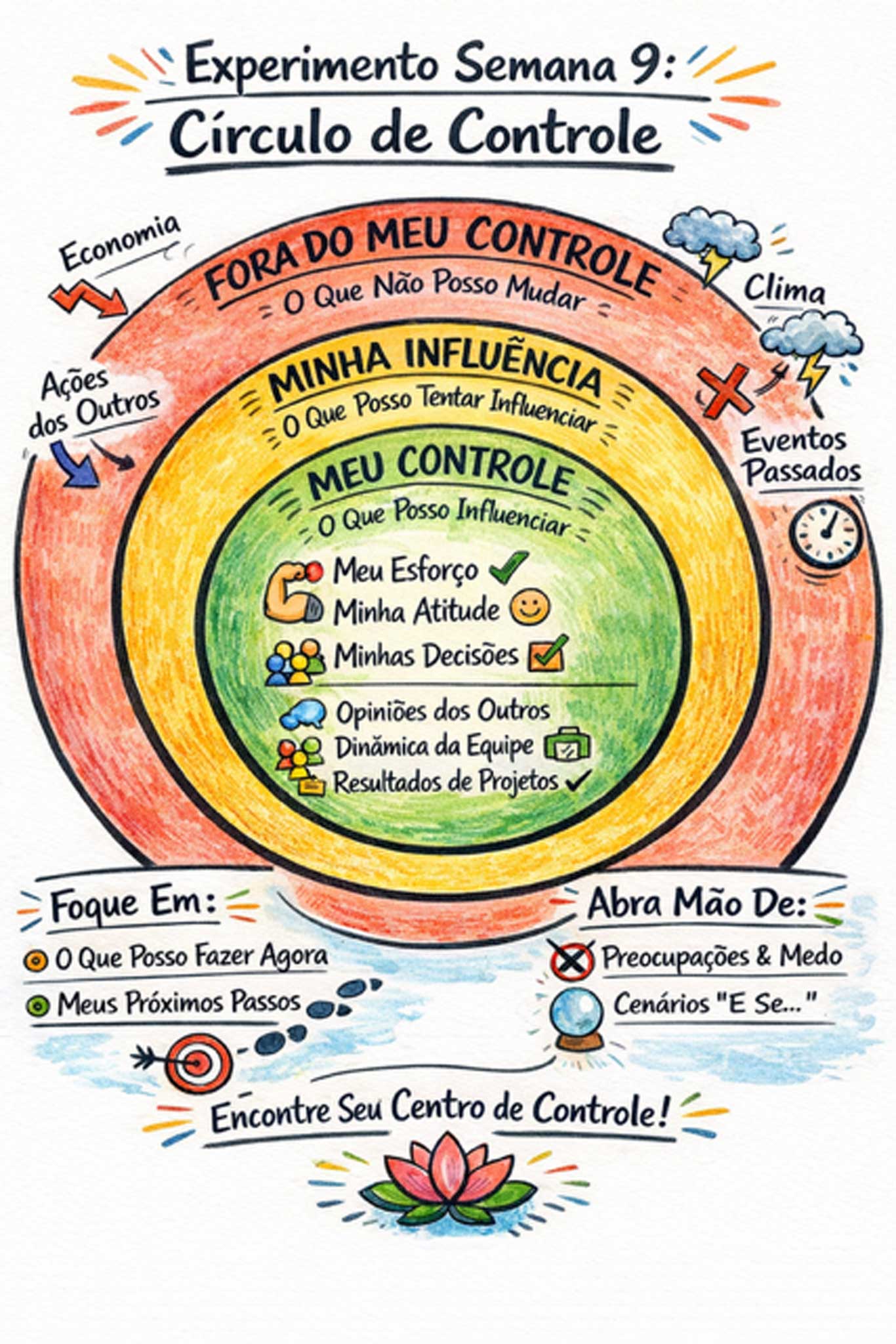
 Finding Your Center
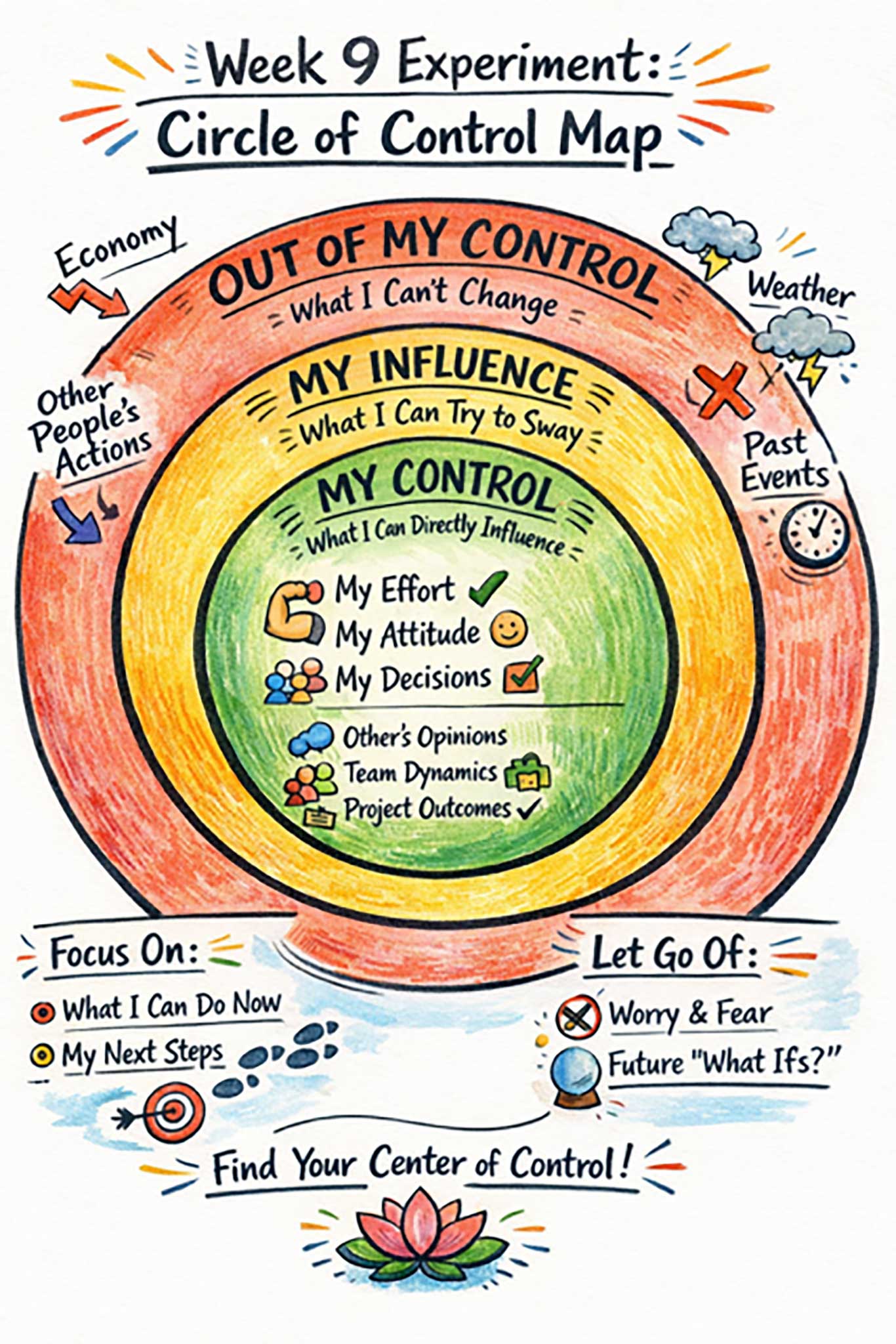
Para visualizar o pôster desta semana em português, clique aqui: Semana 9: O Mapa do Círculo de Controle
This week is about energy management.
In high-pressure environments, we often feel a sense of "systemic overwhelm"—the crushing weight of things we cannot fix. We worry about the economy, the weather, past mistakes, or the unpredictable actions of others. When we give our attention to these "Outer Circle" elements, we leak energy, leaving us exhausted and feeling powerless.
Unlearning the armour means recognizing that we don’t have to carry the weight of the things we cannot change. By mapping out our concerns, we can distinguish between what is Out of My Control, what is within My Influence, and what is under My Control.
The goal isn't to become indifferent to the world, but to become effective within it. When we stop trying to "control" the weather or someone else's opinion and instead focus on our own Effort, Attitude, and Decisions, we find our "Center of Control." This is where our power resides. Clarity here doesn't just reduce anxiety; it transforms "What if?" into "What now?"
- Details
- Written by: Dr Toomas Särev
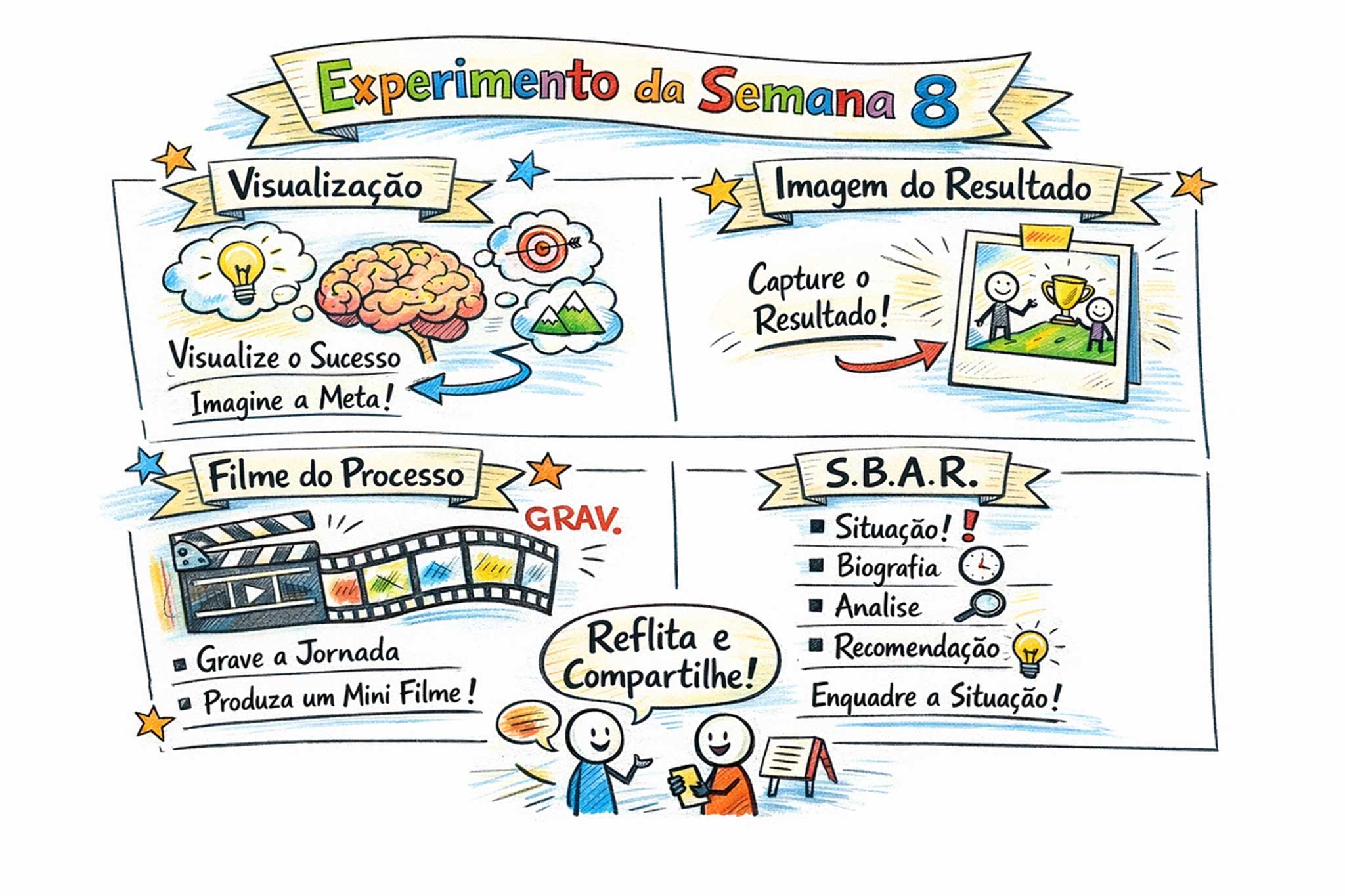
 Visualisation, Process, and Framing Your Story
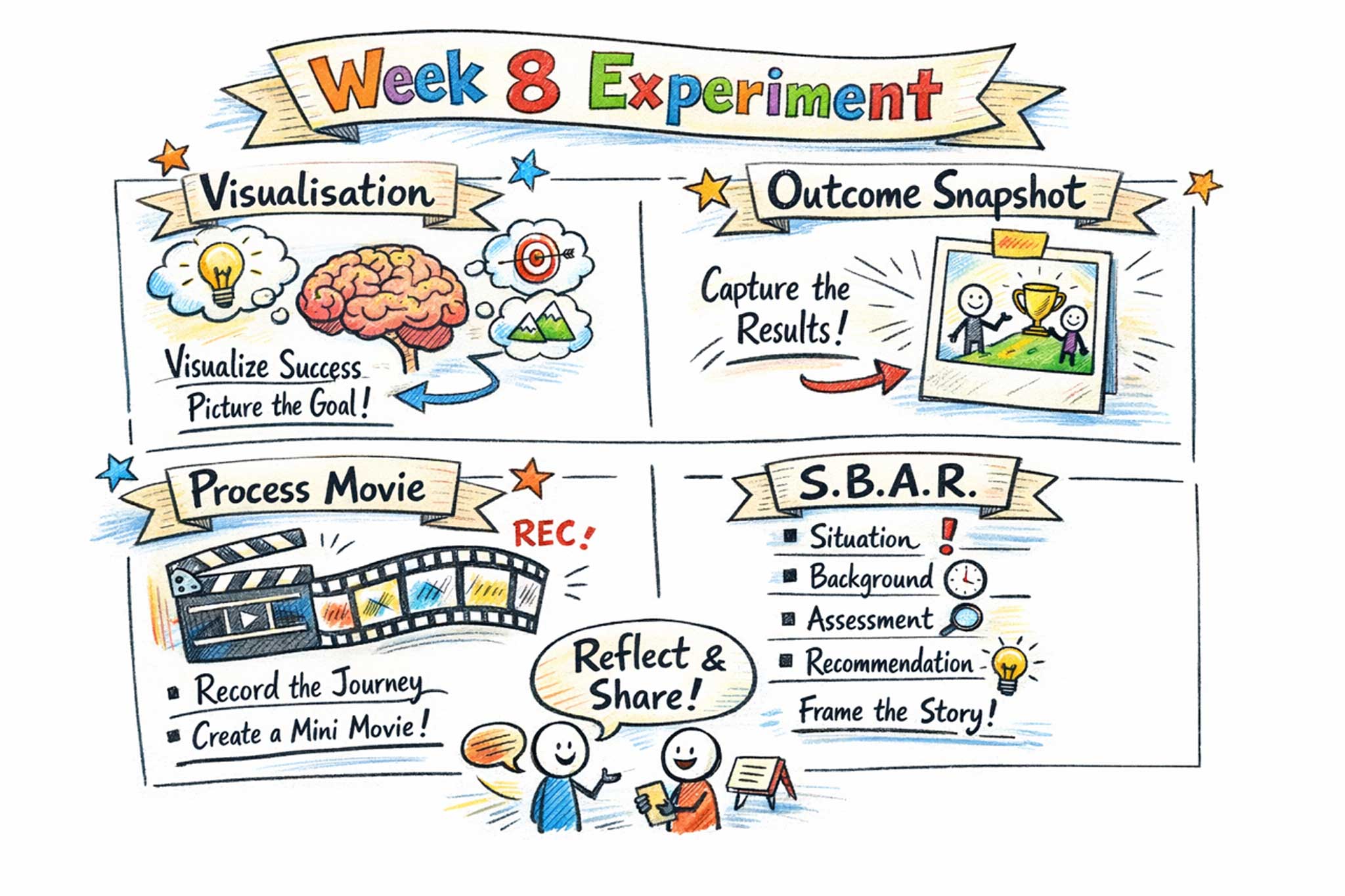
Para visualizar o pôster desta semana em português, clique aqui: Semana 8: Vendo para Alcançar
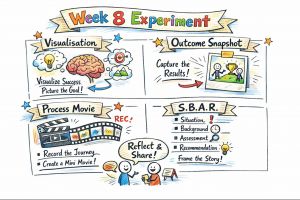
Having spent seven weeks building our inner foundations — pausing, getting curious, recognising our armour, holding our edges — this week we look forward. Resilience isn't only about protecting what we have. It's also about being able to picture where we're going.
This week's experiment brings together four tools:
- Visualisation — picture the goal
- Process Movie — record the journey honestly
- Outcome Snapshot — capture what actually happened
- S.B.A.R. — Situation, Background, Assessment, Recommendation — frame the story clearly
- Details
- Written by: Dr Toomas Särev
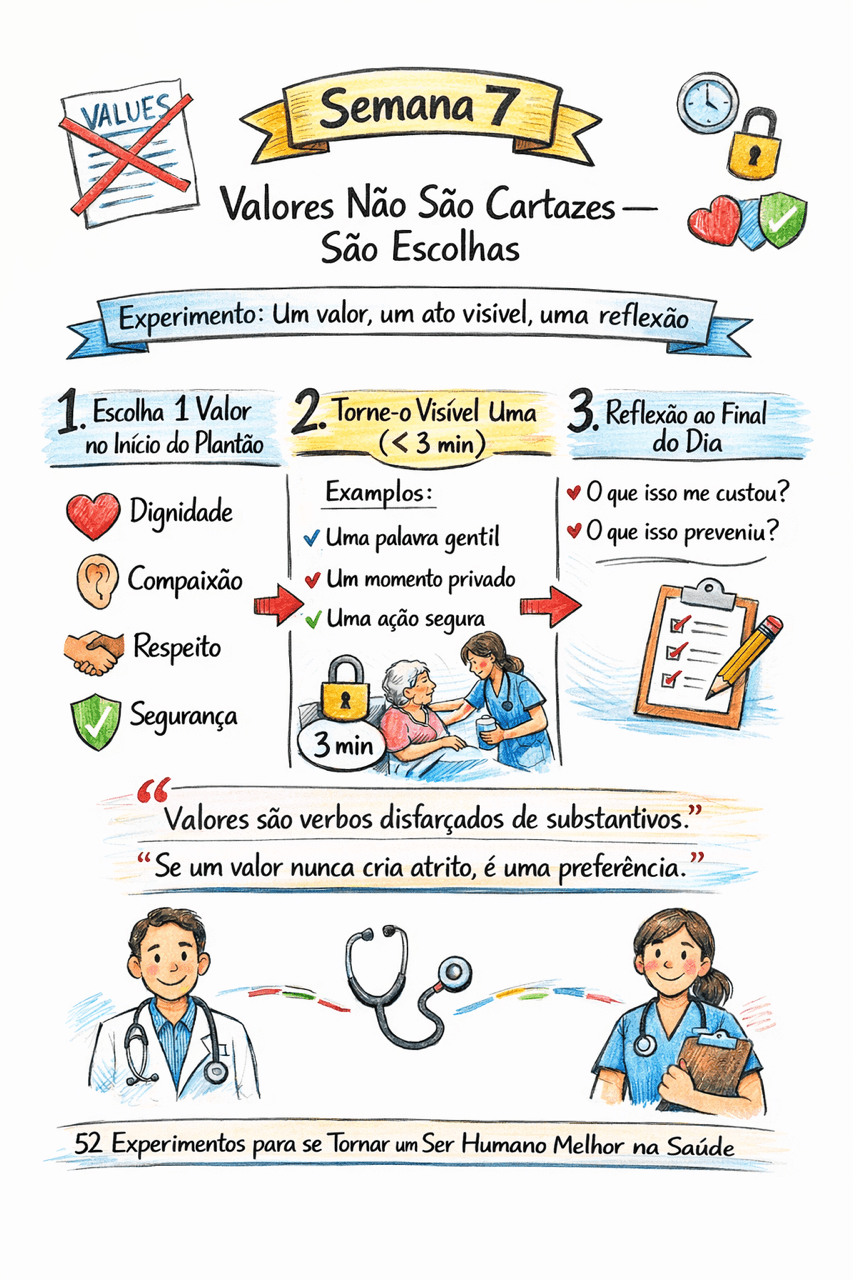
Values as Verbs
Para visualizar o pôster desta semana em português, clique aqui: Semana 7: Valores Não São Cartazes — São Escolhas
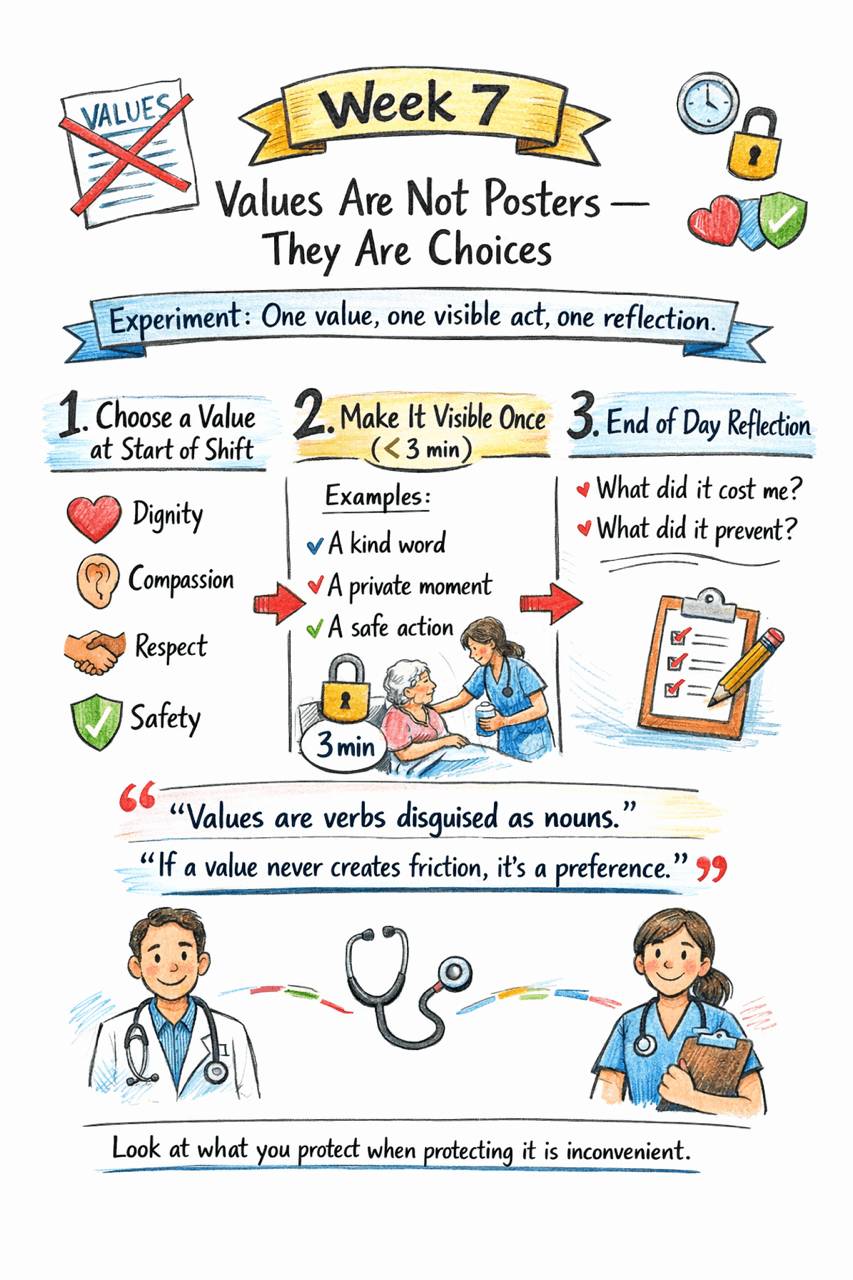 This week is about the transition from inspiration to action.
We often see "values" displayed on the walls of our workplaces—words like Dignity, Compassion, Respect, and Safety. However, values that remain on a poster are just decorations. To have real meaning, values must be treated as verbs rather than nouns. They are the active choices we make, especially when those choices create "friction" or require us to go against the grain of convenience.
In healthcare and leadership, we are often tested not when things are going well, but when the system is under pressure. It is easy to value "Compassion" when we have plenty of time; it is a true value only when we choose it while we are running late. As the experiment suggests, if a value never creates friction, it’s likely just a preference. True values have a cost, but they also serve as a shield—preventing burnout, moral injury, and the erosion of our professional identity.
Sustainable practice requires us to bridge the gap between what we say we care about and what we actually do. By choosing one value and making it visible through a single act, we reclaim our agency within the system.
- Details
- Written by: Dr Toomas Särev
Read more: Week 07: Values Are Not Posters - They Are Choices
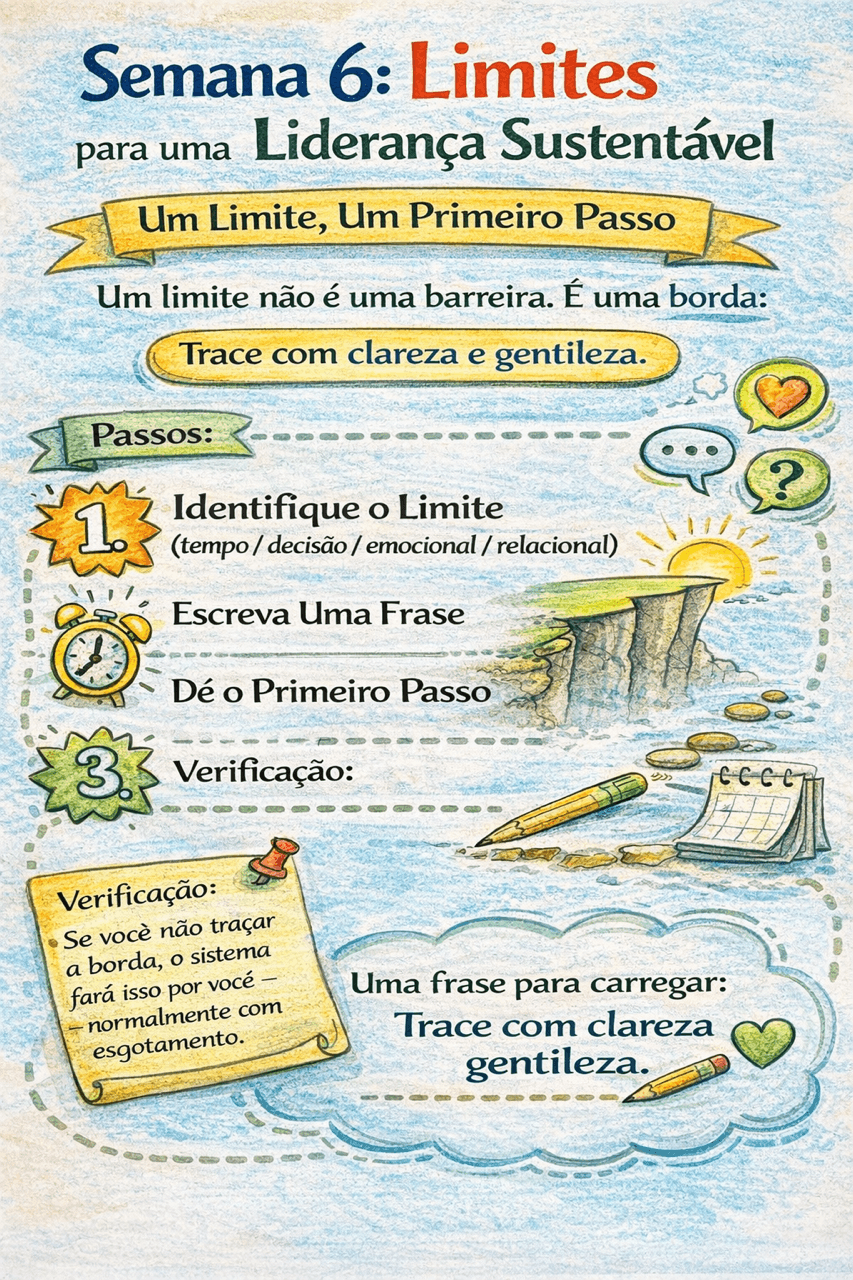
Boundaries — protecting what you’ve built from being given away
Para visualizar o pôster desta semana em português, clique aqui: Semana 6: Limites para uma Liderança Sustentável
 The “Always On” Mode
This week is about boundaries.
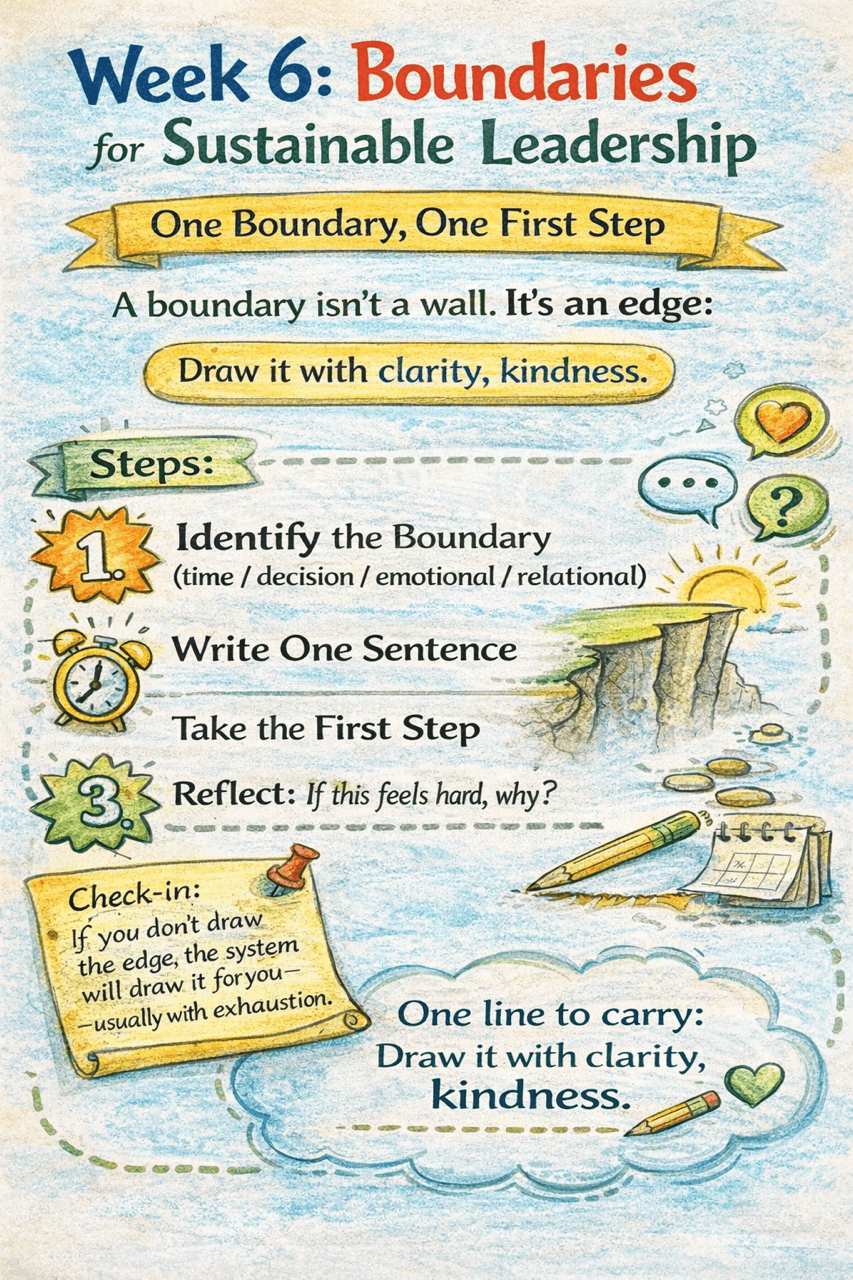
We can learn to read emotions, practice deep curiosity, and be fully present, but without boundaries, none of it holds. We often mistake boundaries for barriers, but they are actually edges. An edge is what stops us from drifting into a "yes" when we truly mean "no." It is the vital distinction between being genuinely kind and being merely compliant, or between helping someone and completely overextending ourselves.
We live in systems that quietly praise those who do "more"—more hours, more availability, more emotional labour. This praise often acts as a trap, turning our natural desire to contribute into a source of chronic guilt. These challenges shift throughout our lives; teenagers may struggle with the FOMO (fear of missing out), while older adults might find boundaries difficult when shifting independence challenges their identity. Ultimately, boundaries are not just about protecting ourselves; they are about respecting the edges of others too.
True sustainable leadership requires us to identify one boundary and practice holding that edge. It might be as simple as stopping emails after 9pm or finally saying what we actually mean. When we practice sentences like "I’m happy to help" or "I can’t be spoken to like that," we must pause and notice the internal reaction, whether it is relief, anxiety, strength, or guilt. Boundaries aren’t about becoming harder or more distant; they are about becoming clearer. Clarity, when held gently, changes everything.
- Details
- Written by: Dr Toomas Särev
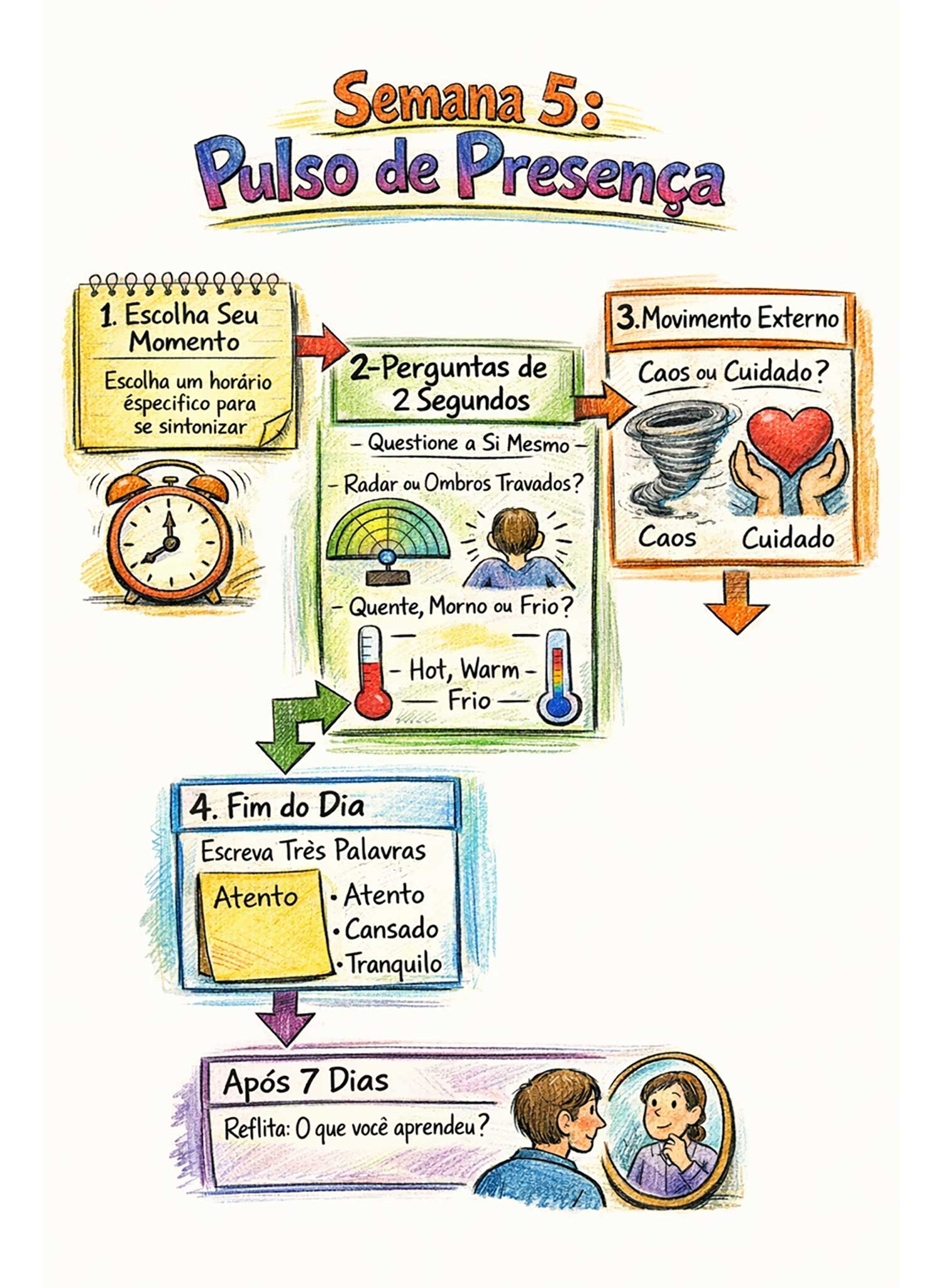
Presence and situational awareness — the human layer switched on
Para visualizar este guia em português, clique aqui: Semana 5: Pulso de Presença.Semana 5: Pulso de Presença.
The “Always On” Mode
There is a state many of us live in without even realizing it. We aren't necessarily busy or overwhelmed, but we are "braced". It is a half-presence where we are constantly scanning for what might go wrong. While this feels responsible, prepared, and efficient, it comes at a significant cost. When we are braced, we don’t really notice reality; we misread situations, forget to pause, and shield ourselves from the present. Curiosity quietly disappears, and without that curiosity, our genuine connection to others fades too.
Chronic stress acts as a double-edged sword in this environment. It can make us effective, helping us move through tasks quickly, make rapid decisions, and keep the plates spinning. However, that same speed reduces our sensitivity and reflection. We lose the space to truly consider our actions. We become efficient, but we are no longer present. Presence isn’t about slowing life down; it’s about stepping fully into it, and often, that can start with a single pulse of noticing.
The Present Pulse: A Small Practice
- Details
- Written by: Dr Toomas Särev
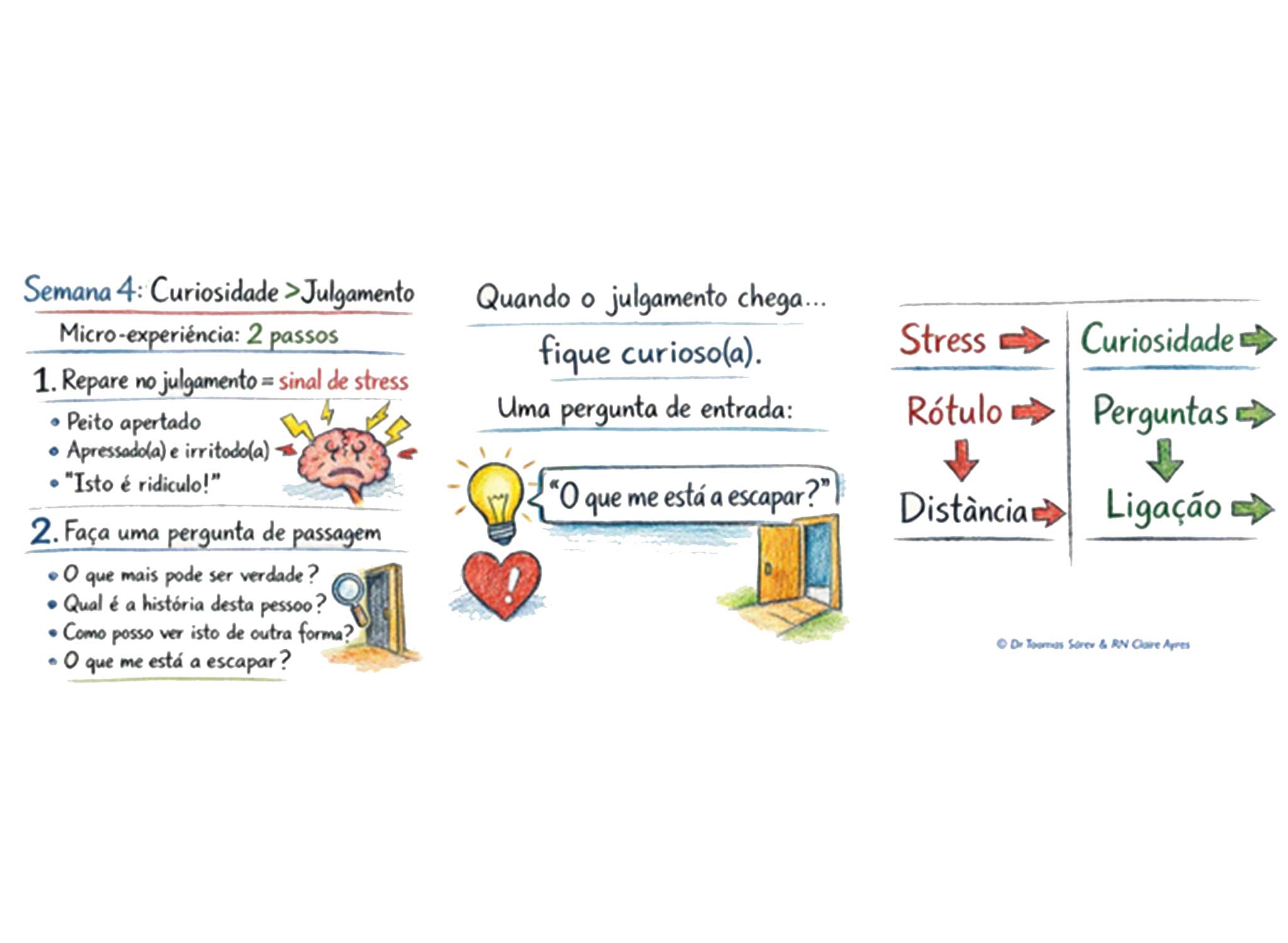
Curiosity as the antidote to judgment
Curiosidade da semana 4: clique aqui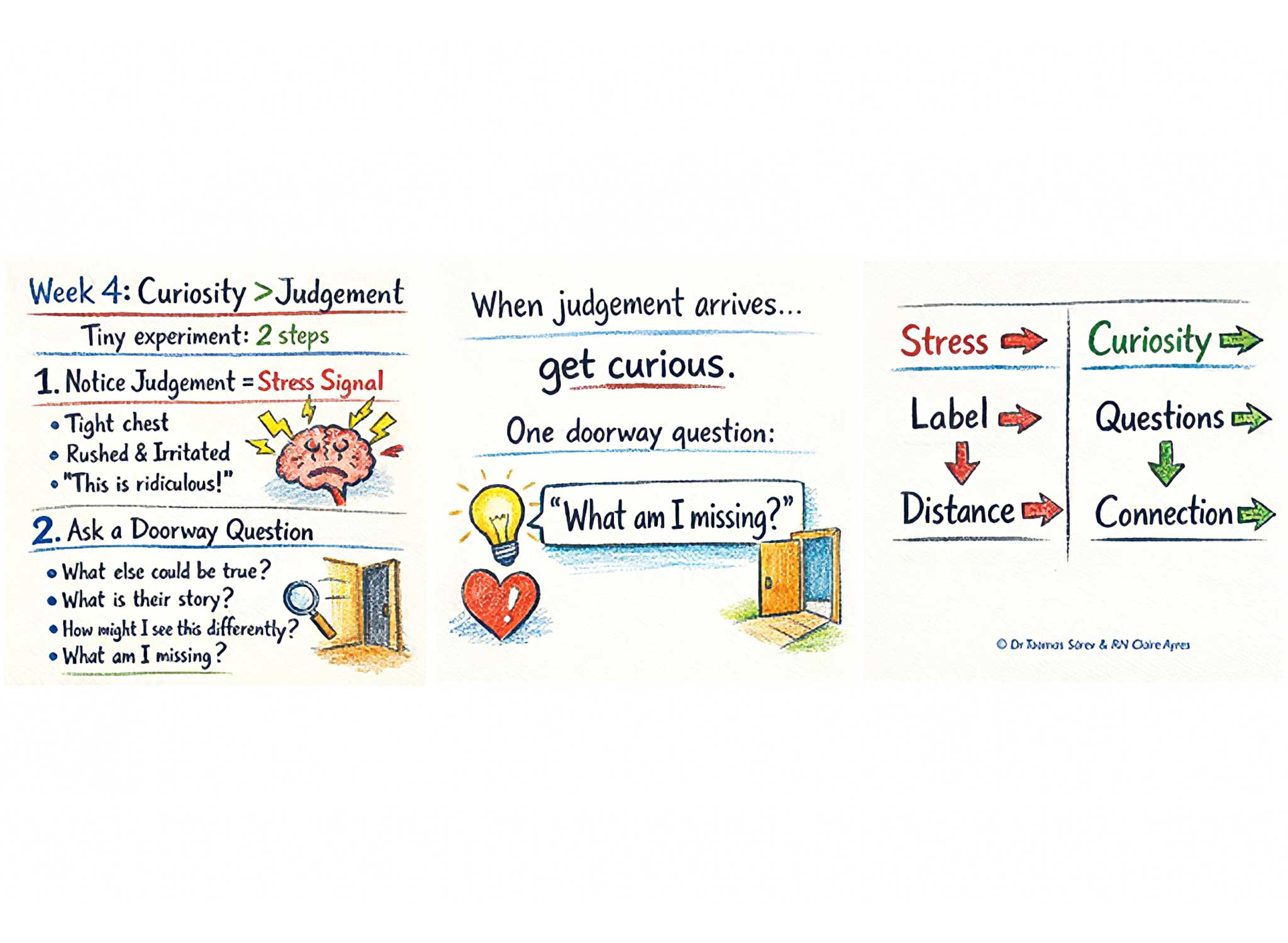 Our brains like to make things easy. When life feels busy, stressful, or overwhelming (too many plates spinning), concentration drops and we start jumping to conclusions. This isn’t a flaw — it’s how our brains cope.
Over time, repeated thoughts and emotional responses create familiar pathways, like ruts in a well-travelled road. Without realising it, we can get stuck in these patterns. We may not be able to name it — we just know something isn’t working.
This is where curiosity helps.
Instead of asking “Why?” (which often brings judgement and defensiveness), try asking “What?”
-
What am I noticing right now?
-
What might I be missing?
-
What’s really going on for me?
“What” questions open space. They slow our automatic reactions and help us step out of old ruts. You don’t need to fix everything — just start noticing.
Get curious. Awareness is often the first step towards change.
- Details
- Written by: Dr Toomas Särev
Emotional intelligence — feelings as information, not noise
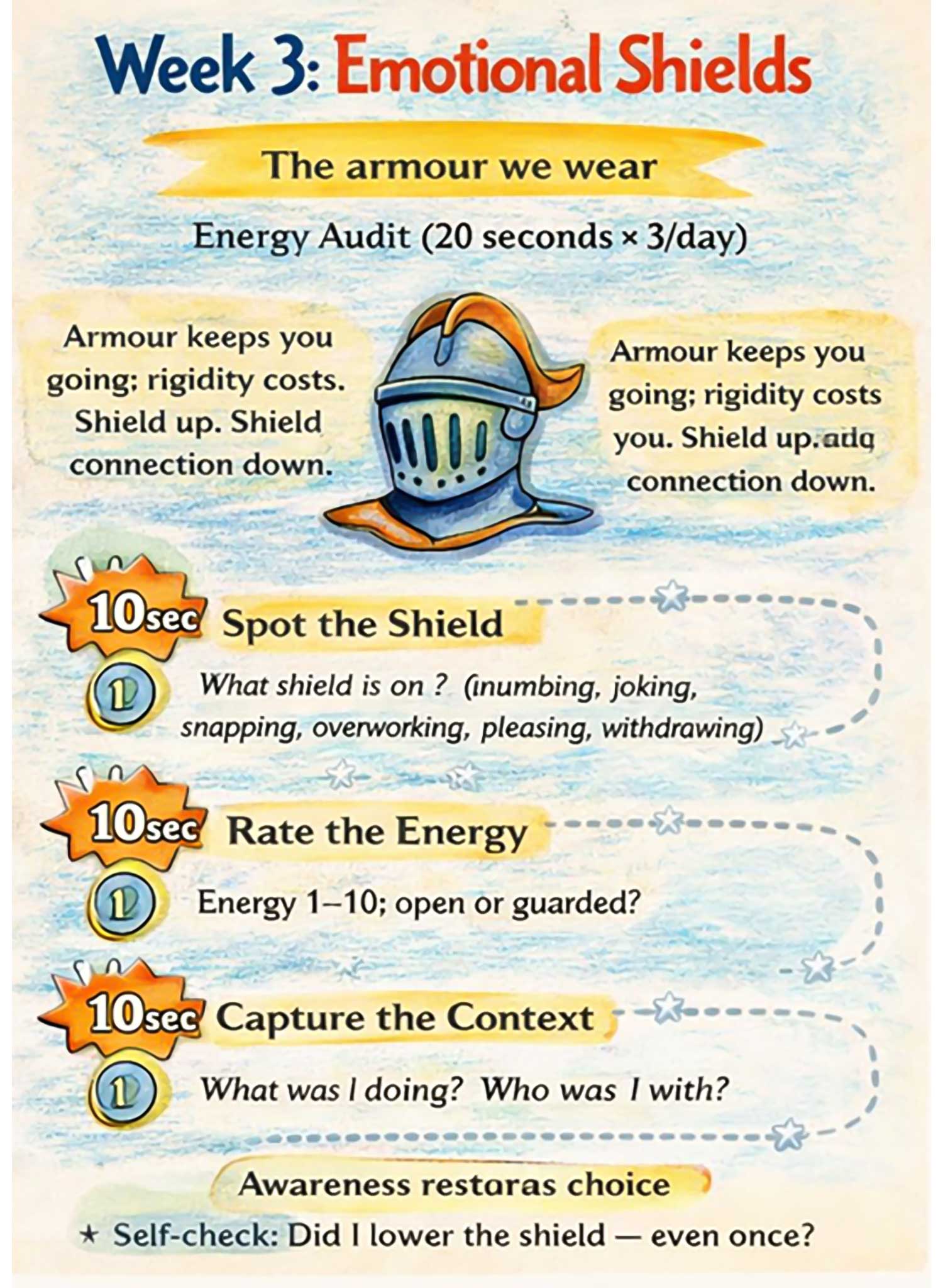
To navigate life and protect ourselves, we often learn—sometimes without realizing it—to hold in our emotions, to hide what we truly feel. Like a gambler carefully guarding their next move, we build a kind of armour: a protective shell that shields us from hurt and helps maintain our self-esteem.
This is normal. It is part of how we cope.
But when this armour becomes constant, always on, it can start to distance us from ourselves. Our reactions may no longer reflect what we truly want or feel. We may find that the person behind the armour feels hidden, even from ourselves.
One way to understand this armour is to notice our triggers. When do we feel the need to put it on? When do we hold our emotions tightly inside? Which people, places, or situations fill us with energy, joy, and connection—and which leave us feeling drained, guarded, or closed off?
By observing these moments, we begin to see not only the armour we wear but also the freedom to choose when, and with whom, we truly lower it. In doing so, we reconnect with ourselves—and with the life that gives us energy and joy.
Dr Sarah on Call MH week 3 and January Blues 27.1.26
- Details
- Written by: Dr Toomas Särev
Emotional intelligence — feelings as information, not noise
Haz clic aquí para ver el póster en español
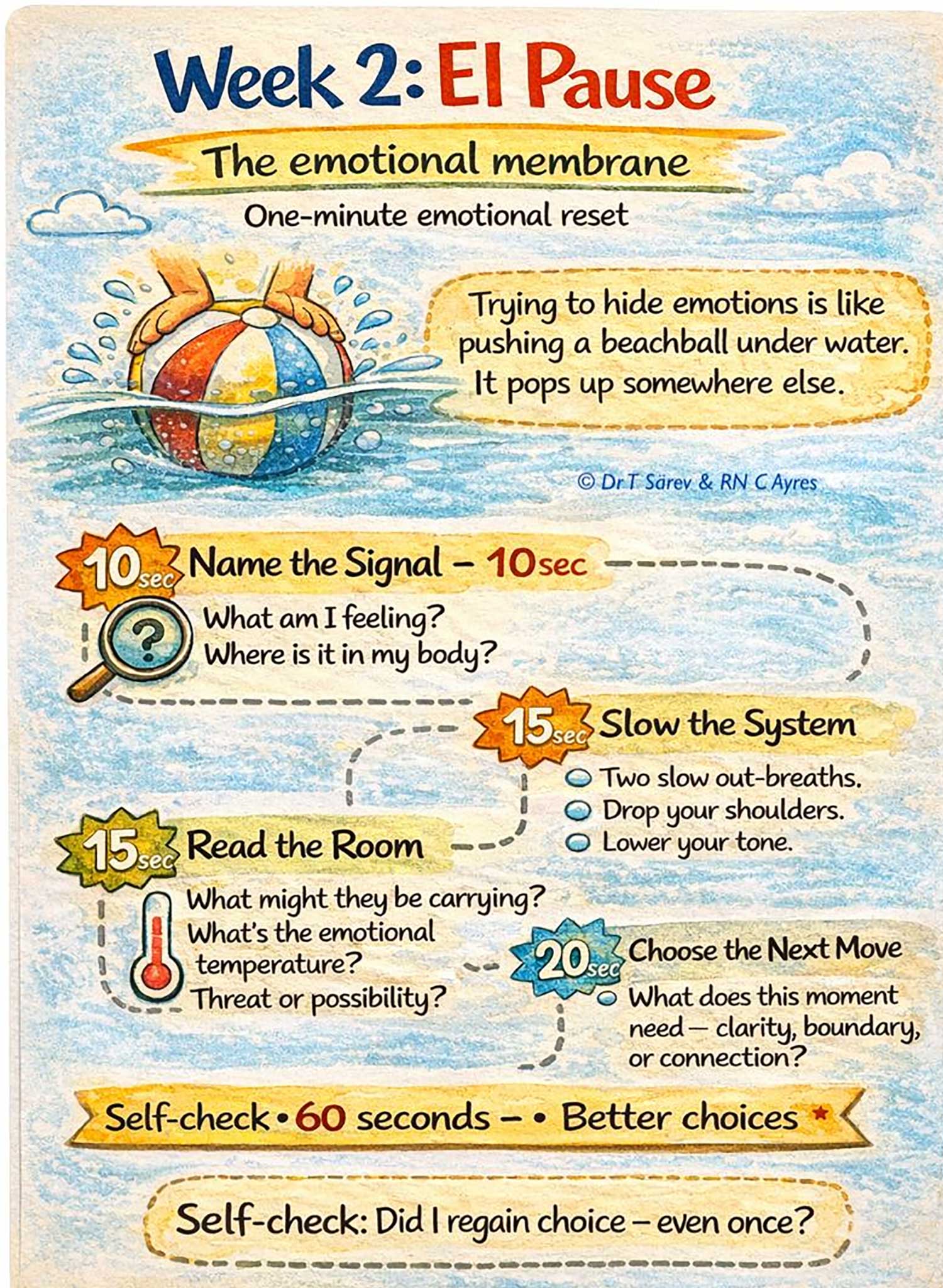
The focus this week is ’The Pause ‘— learning to pause before reacting.
Notice where stress or anxiety shows up in your body? Is it your chest, shortness of breath, a sensation in the pit of your stomach like the downwards twist in a rollercoaster, or maybe a headache?
Pause
Take a breath
Look around you
The choose how you respond
This small moment of awareness can create space, calm, and choice- even in the middle of a busy or pressured day
Dr Sarah on Call: Step 2 Mental Health, Viral or Bacterial Infection - how can you tell?
- Details
- Written by: Dr Toomas Särev
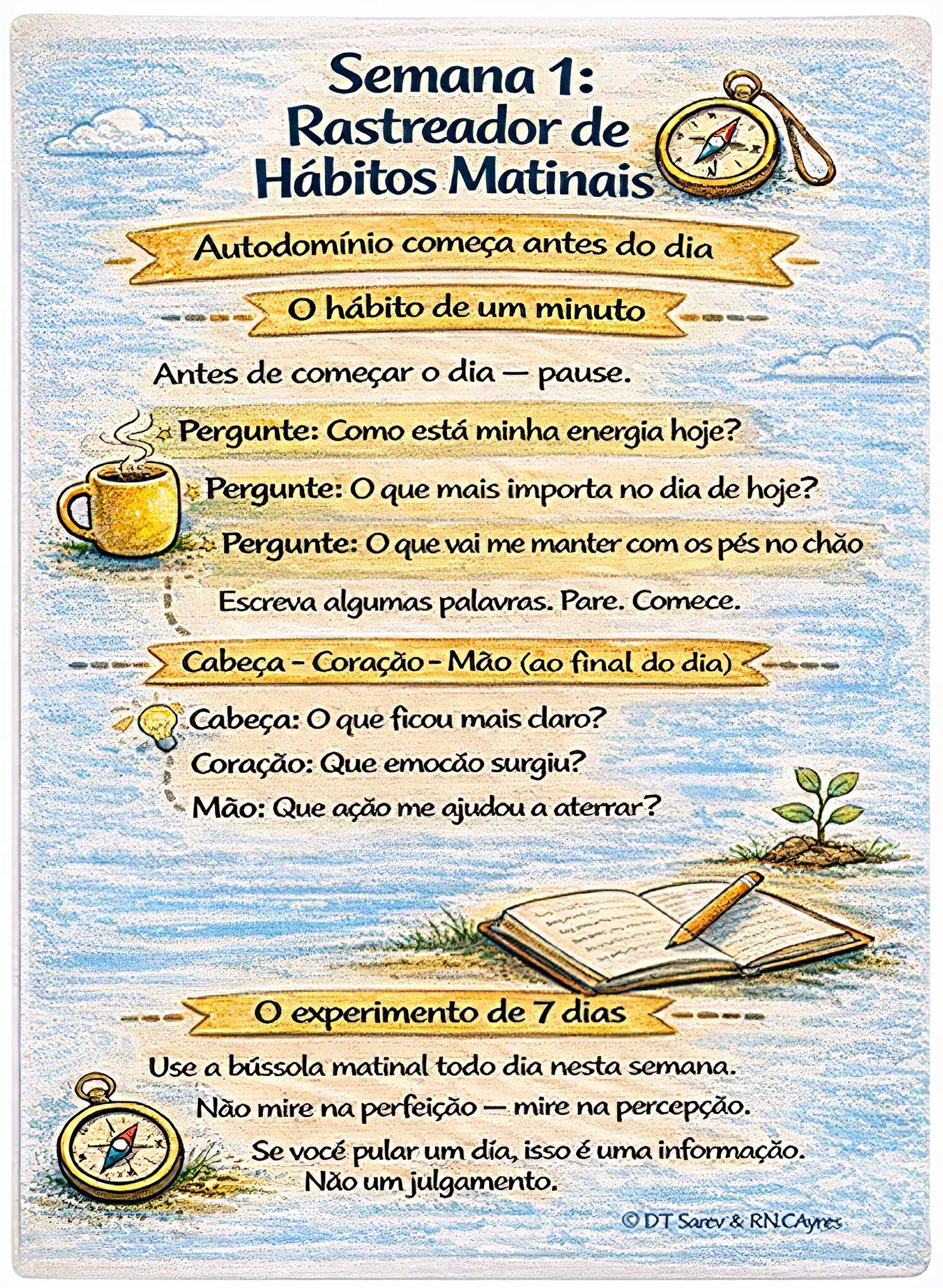





Começamos os primeiros 52 experimentos de dois minutos projetados para construir resiliência — práticas pequenas e intencionais que se encaixam na vida real.
No início de cada dia, reserve um momento para notar como está o seu "tanque": cheio, meio cheio ou chegando na reserva.
A partir daí, identifique apenas uma coisa que você deseja alcançar naquele dia — o comportamento ou a tarefa que fará a maior diferença para você.
Por que isso importa? Cabeça (pensamentos), Coração (sentimentos) e Mãos (ações).
A antecipação e o estresse podem moldar silenciosamente nossos dias antes mesmo de eles começarem.
-
Se você espera um dia difícil, isso afeta seu sono?
-
O sono ruim torna o dia mais difícil, criando um ciclo vicioso?
À medida que avançamos no curso, observe: entender seus níveis de energia e escolher metas gerenciáveis melhora sua sensação de conquista e aumenta sua autoconfiança?
- Details
- Written by: Dr Toomas Särev
Read more: Semana 1: Construindo Resiliência, uma Pausa de cada vez
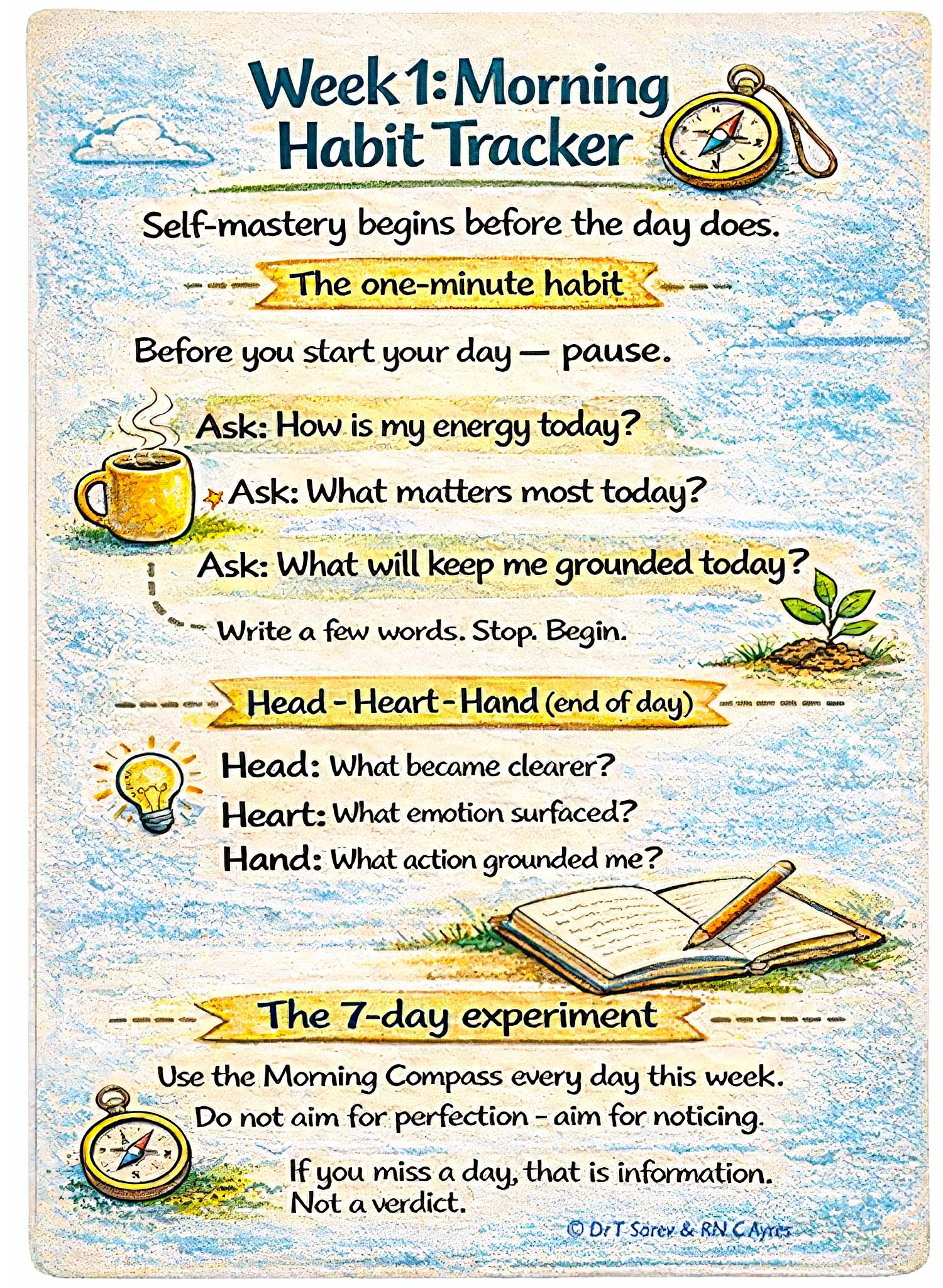
Self-mastery — creating a centre before the day grabs you
Clique aqui para o Rastreador de Hábitos Matinais da Semana 1 (Sua Bússola Matinal)
We begin the first 52 two-minute experiments designed to build resilience — small, intentional practices that fit into real life.
At the beginning of each day take a moment to notice where your tank is: full, half -full or running into empty.
From there identify just one thing you want to achieve that day, which is the thing / behaviour that will make the most difference to you. Why does this matter. Head (thoughts), heart (feelings) and hand (actions).
Anticipation and stress can quietly shape our days before they even begin.
If you expect a difficult day does that affect your sleep?
Does poor sleep make the day harder creating a self-fulfilling cycle
As we move through the course. Does understanding energy levels, choosing manageable goals, improve sense of achievement and drive increasing confidence.
- Details
- Written by: Dr Toomas Särev