
A versão em português do cartaz desta semana está disponível aqui.

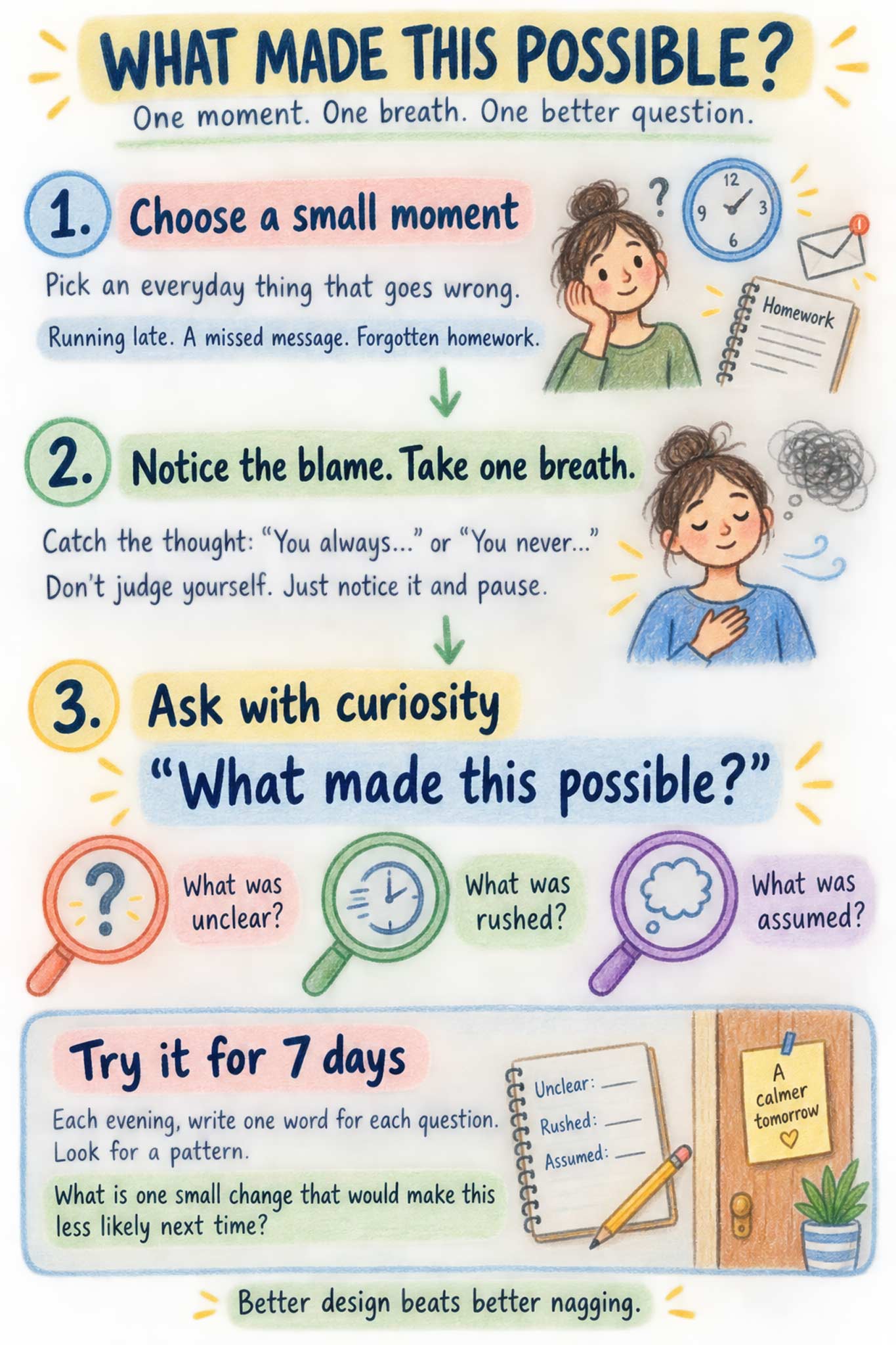 Deep into the relational quarter, Dr Sarah Flindall and Dr Toomas Särev turn to one of the fastest reflexes any of us have: blame. Something goes wrong, and almost at once the question becomes "Who did it? Who forgot? Who left the door open?" With exam season under way, winter pressure building in the NHS and families juggling work, money and care, the blame reflex rises with the pressure. Toomas describes blame as an emotional painkiller. It gives an uncertain room a tidy story and somewhere to put the discomfort, and for a moment everyone breathes out. But painkillers are not diagnostics. Blame quietens the pain without explaining it, and it stops the thinking far too early. The cost is a child who becomes ashamed instead of curious, or a team that goes quieter rather than safer.
The shift they explore is from a person to a pattern. Using a missed scan result in a busy clinic as an example, Toomas shows how one interruption, one assumption or one short-staffed afternoon can let something slip. A process that relies on one tired person remembering everything is an unsafe process, because good systems don't rely on perfect people. The same shape turns up at home. A teenager's "I forgot" is heard as "I don't care". An argument about housework becomes an argument about character. An older parent's missed medication becomes "you're being stubborn" when the real worry is fear. None of this means nobody is responsible. Blame looks backwards and asks whose fault it is, while accountability looks forward and asks what happened, what needs repairing and who owns the next step. Toomas offers one sentence for any kitchen table, staff room or ward: "Before we blame, can we understand what made this more likely?"
This week's experiment: "What made this possible?" Choose one small, ordinary moment when something goes wrong, such as someone running late, a missed message or forgotten homework. Notice the blame sentence that wants to come out ("You always…", "You never…") without judging yourself for it, and take one breath. Then ask "What made this possible?" and look for three things: what was unclear, what was rushed and what was assumed. Each evening for seven days, write one word for each and look for a pattern. To go further, ask what one small change would make it less likely next time, such as a note by the door, a shared list or a five-minute family reset. Better design beats better nagging.
This isn't about letting people off the hook. Responsibility still matters, and so do boundaries. Where someone's safety is at risk, deal with that first and ask the curious question afterwards. The experiment applies when the blame is aimed at yourself too: the point is to understand, not to find a new stick. As Toomas puts it, blame protects us from discomfort, but curiosity protects us from repetition.
Listen to the full episode below.