
A versão em português do cartaz desta semana, sobre a porta aberta que ninguém atravessa e sobre o corredor que é preciso percorrer para lá chegar, está disponível aqui.

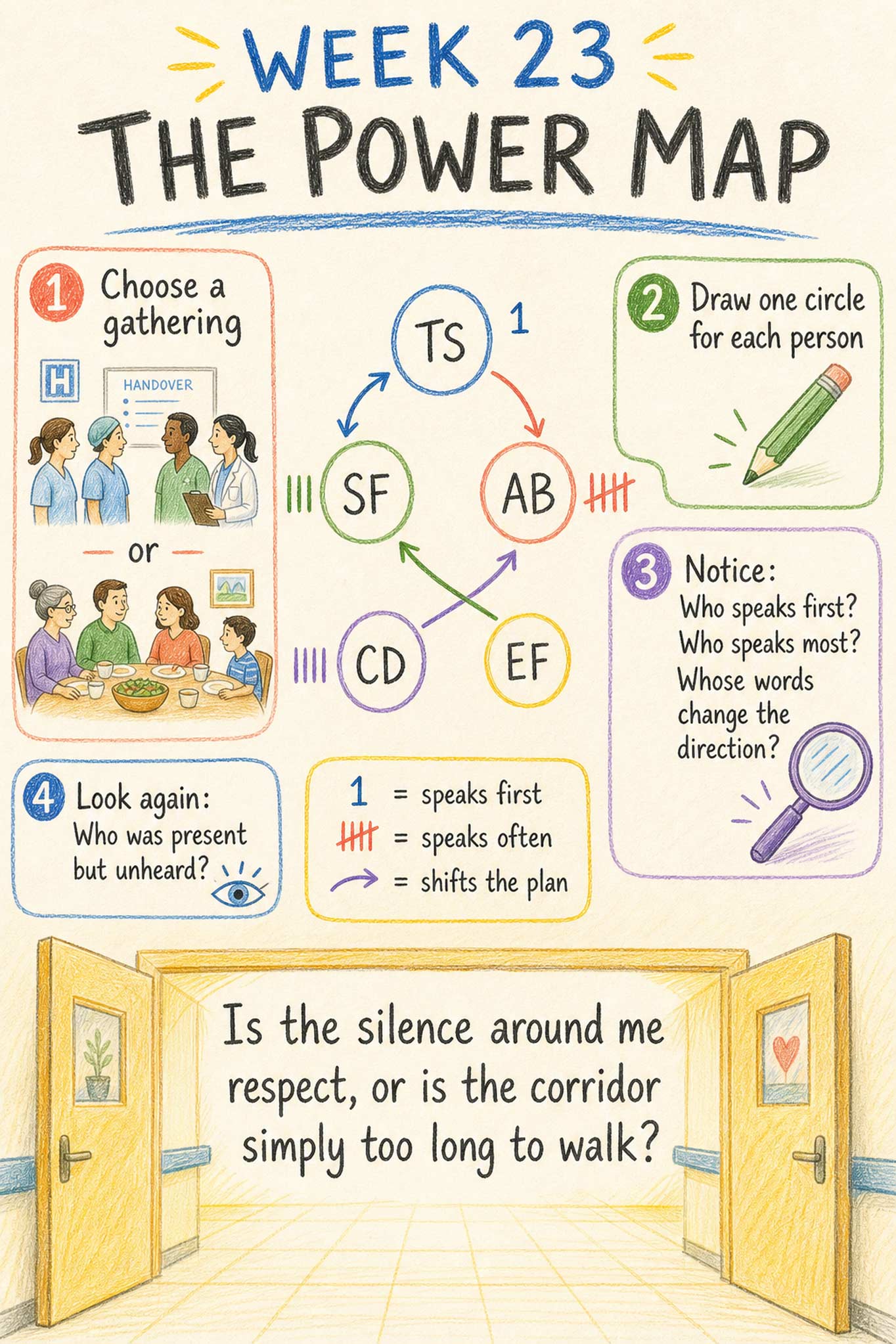 Week 23 of Unlearning the Armour starts with a sentence almost every leader has said: "my door is always open." Nothing is wrong with it — it's sincere, it's kind, and it's often useless, because the door was never the problem. Dr Toomas and Dr Sarah look instead at the corridor: everything a person has to walk through to reach that open door, built from hierarchy, memory, and the look on someone's face the last time a concern was raised. A consultant says it and means please come. A junior hears you may enter, but you will carry the cost. There are two kinds of power in any room — the kind printed on the badge, which you can draw on an organisational chart, and the kind you can only feel: who gets interrupted, whose idea lands only when someone senior repeats it, whose silence reads as wisdom and whose reads as not pulling their weight. Toomas is fair to authority — in a cardiac arrest you need one clear leader, not a committee — but authority without awareness extracts compliance and mistakes it for agreement. There's a hard story here from Claire, about a warm poster on the wall, one nurse who believed it, and what the whole unit learnt when she came back and handed in her notice. The poster stayed up. Nobody else walked through that door.
This week's experiment: the Power Map. Take one gathering — a board round, a handover, a family meal — and draw a small circle for each person. Notice three things as it unfolds: who speaks first, who speaks most, and whose words actually change the direction. Number the first speaker, tally the rest, and draw an arrow whenever someone's contribution shifts the plan. Then look at who has nothing beside their circle — present in the room, absent from the conversation. And if the arrows all come from you, there's one more question: is the silence around me respect, or is the corridor simply too long to walk? Toomas leaves us with the reason it matters. If the truth can't reach you early, it reaches you late — as a complaint, an incident or a resignation. It always arrives; the only question is whether it arrives in time to be useful.
Listen to the full episode below.