 I didn’t start writing until I was 50. Here’s what happened next.
There are some things we tell ourselves we’ll do one day — Writing a book was mine.
I had always wanted to write, but somehow life kept happening first. There was work, family, responsibilities and all the ordinary things that fill the years rather more quickly than we expect them to.
Then I turned 50.
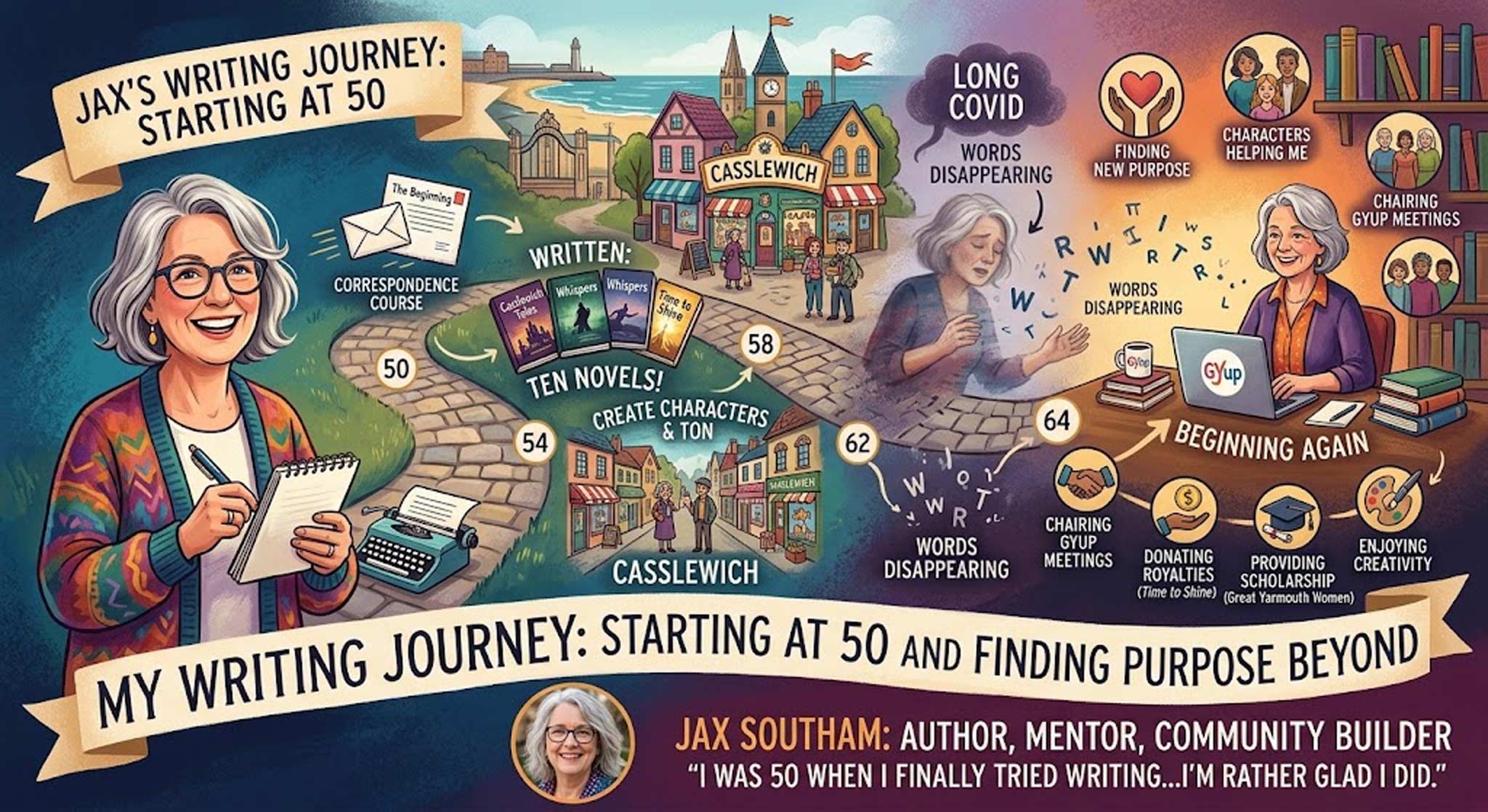
My husband, Duncan, knew that writing was something I had always wanted to try, so for my 50th birthday he bought me a creative writing course. Not an online course. This was a proper correspondence course. I wrote my assignments, put them in an envelope, posted them off and waited for them to come back marked. It already sounds like something from another age.
But I began.
And that turned out to be the important bit. Over the next fourteen years, I wrote ten novels. I created characters I loved, mysteries I wanted to solve and, eventually, an entire fictional town called Casslewich. Writing became a huge part of who I was. My plan was simple. When I eventually retired, I would finally have all that lovely uninterrupted time to write.
Life, unfortunately, had not read the plan.
When the words disappeared
Long Covid brought my working life to an end earlier than I had expected. But it also affected something else.
Words.
For a writer, it was a particularly cruel trick. I struggled to understand words I knew. My spelling disappeared. I could begin a thought and lose it before I reached the end. Following a complicated thread became exhausting. The thing I had been waiting to have more time for suddenly became something I couldn't do in the same way. And that was difficult. Not simply because I couldn't write.
It was difficult because writing had become part of who I was.
I think that's something we don't always recognise about major changes in our lives. We notice what we've lost — a job, a relationship, our health, a role we've held for years — but underneath it there can be another loss. For a while, we're not entirely sure who we are without it.
Beginning again
Eventually, I found my way back to writing, although not by forcing myself to become the person I'd been before.
And, rather wonderfully, some of the characters I'd created helped.
Looking back at the women I'd written over the years, I began to notice something. They weren't all the same. They didn't cope with life in the same way. They had different strengths, different flaws and very different ideas about what mattered. Yet each of them found a way to move forward while remaining themselves. I'd apparently spent fourteen years writing about something I now needed to learn. That discovery eventually led me into another new chapter of my life — one I certainly hadn't been planning at 50.
Perhaps “is it too late?” is the wrong question
I sometimes wonder what would have happened if Duncan hadn't bought me that writing course.I could easily have reached 50 and decided I'd left it too late.
I hadn't.
Nor, as it turned out, had I left it too late at 64 when life changed direction again. I don't think beginning has an age limit. And beginning doesn't have to mean doing something enormous. It might be writing the book you've talked about for twenty years. It might be learning to paint, joining a choir, taking a course, volunteering, travelling somewhere you've always wanted to see, or simply discovering what you enjoy now rather than automatically doing what you've always done.
Sometimes the beginning is even smaller than that. It is allowing yourself to wonder:
What would I like to try?
- Not What am I good at?
- Not Will this lead anywhere?
- Not What will everyone else think?
Just: What would I like to try?
I was 50 when I finally tried writing. Ten novels later, I'm rather glad I did.
Jax Southam is a Great Yarmouth author and GYup member. She chairs GYup's weekly meetings, donates the royalties from her novel Time to Shine to GYup, and provides the Great Yarmouth Scholarship for local women experiencing significant life change.