Inspired by Geoffrey Smart — From Physics to People to Politics
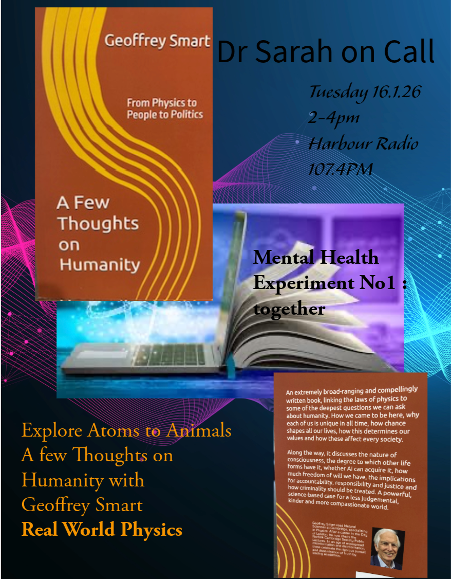
On the 13th January Geoffrey Smart Joind me on my Harbour Radio Show, Geoffrey is the author of "A Few Thoughts on Humanity - From Physics to People to Politics"
Some books don’t give you answers. They quietly rearrange the way you think. A Few Thoughts on Humanity is one of those books. It takes you on a journey that starts with physics, travels through biology, and lands squarely in the heart of what it means to be human. It moves from atoms to people, from molecules to morality, from science to society. And what it asks, again and again, is this:
 From Atoms to “Me”
Every one of us begins as atoms. Not metaphorically. Literally.
The atoms in your body were forged in ancient stars, scattered across the universe, and slowly gathered into molecules, cells, organs, and eventually into you. Your DNA is not just a biological blueprint — it is a record of billions of years of cosmic and evolutionary history. So when I say “me,” what am I actually talking about? I am a particular arrangement of atoms, shaped by DNA, refined by experience, moulded by relationships, trauma, love, fear, and curiosity. The same is true for you. We are not just genetic inheritance; we are the total of everything that has ever happened to us. Every thought you have, every feeling, every decision you make is the result of this extraordinary chain of events — from physics to chemistry, from evolution to environment.
That leads to a deeply uncomfortable but fascinating question:
How free is our will, really?
If our brains are physical systems, responding to inputs, memories, emotions and conditioning, how much of our choice is truly “free”? And if that is true for us…
What will it mean for artificial intelligence?
If humans are atoms that can think, feel and reason, what happens when we build machines that can do the same?
The World We Grow Inside
One of the book’s most powerful ideas is that nothing about us exists in isolation. Our beliefs about goodness, kindness, fairness and justice do not appear from nowhere. They grow inside us, shaped by the societies we live in. If a child grows up in a world of cooperation, trust and compassion, those values become wired into their neural and emotional architecture. If they grow up in a world of competition, winners and losers, fear, inequality and blame, those patterns get written into them too.
Not just metaphorically — biologically.
Our brains physically adapt to the environments we live in. Our “atomic structure” of thoughts, emotions and expectations reflects the world that formed us. So when we look at society and ask, “Why are people so angry? Why so disconnected? Why so divided?” we are often really asking: What kind of environment did we build them in?
The Past Is Not a Prison
One of the most hopeful messages running through this book is this:
Nothing is unchangeable.
You are not a prisoner of your past. Your history is not a life sentence. It is a lesson. Yes, our atoms, brains and beliefs are shaped by what has happened to us — but they are also capable of change. Knowledge brings insight. Insight brings choice. And choice brings hope. Understanding how we became who we are gives us the power to become something else.
Why the Young Matter Most
All of this leads to one simple, urgent conclusion. If humans are shaped by their environment, then the most powerful thing we can do for the future is this:
Protect, nurture and invest in the young.
Children and developing minds are not just individuals — they are the future architecture of our society. They are the carriers of what we choose to value. If we fill their worlds with curiosity, integrity, safety, compassion and connection, we quite literally build a better humanity. For me, that makes young people something sacred.
- They are not a problem to be managed.
- They are not a burden to be controlled.
- They are, in the truest sense …
Our army of angels for the future.